
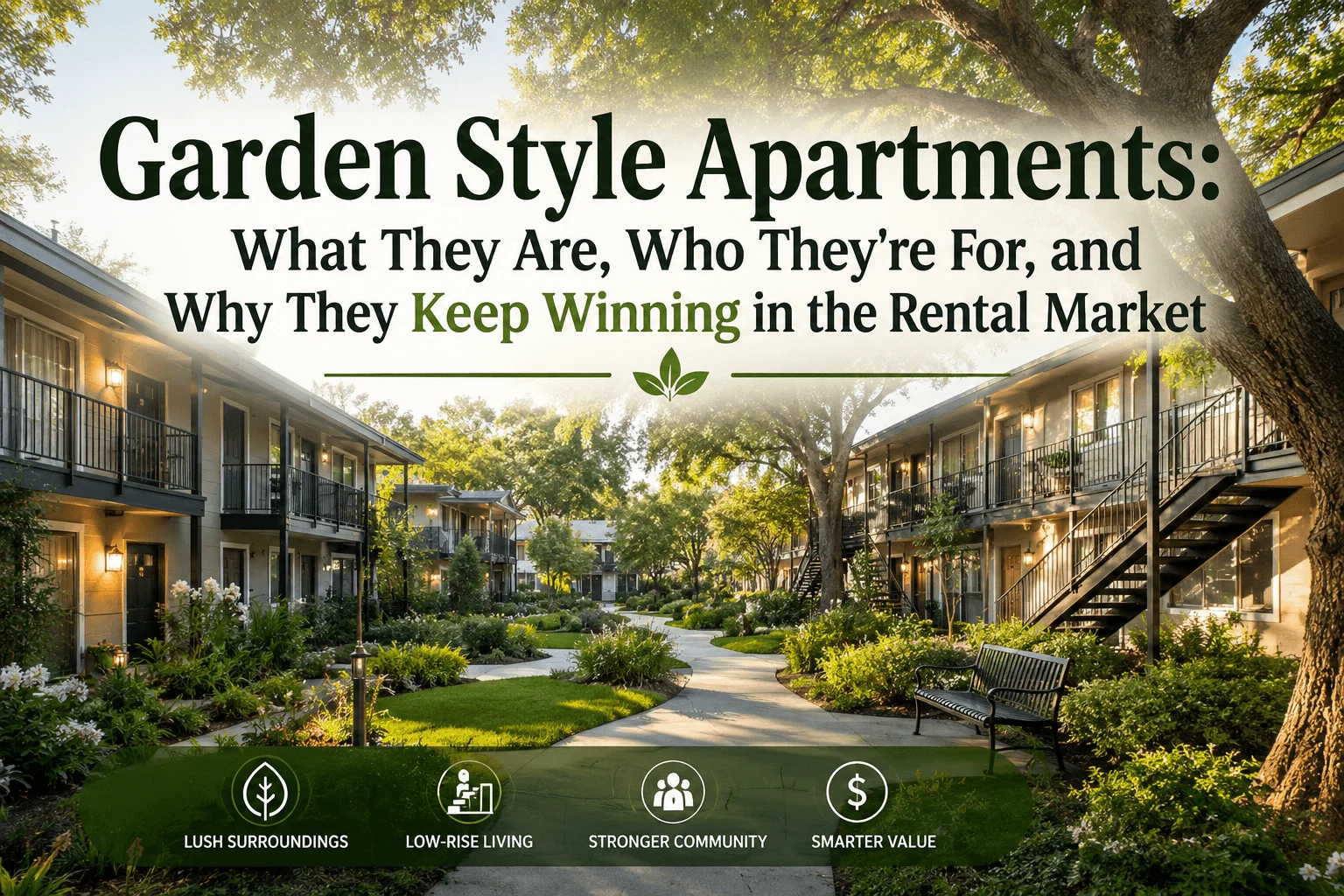
There is a distinct type of apartment that does not scream “Luxury” to you as you pass by it. No doorman, no rooftop area to lounge under the clear blue sky, and certainly, there are no fancy towers with glass panels to catch the afternoon rays of sun. You will enter through an open garden, listen to the songs of birds instead of elevator rings, and end up at the front door of a building that actually feels like home, despite being an apartment complex in the middle of the city. These are some of the things that make garden style apartments unique enough to stay relevant within the current housing market saturated with luxurious amenities.
Knowing the true strengths and weaknesses of garden style apartments is the key to making a smart choice regarding your future home.

What Exactly Is a Garden Style Apartment?
“Style” may be a term with multiple meanings, but the garden style apartment is an architectural phenomenon defined by its own set of characteristics. Specifically, garden apartments are characterized by their low-rise structure and horizontal layout: two or three-story buildings constructed across a large footprint rather than rising up from the ground.
The defining characteristic of such apartments is not the presence of a garden, but the fact that landscaping, greenery and outdoor environment play an important role in designing the property. Open air breezeways take the place of corridors and exterior staircases are located along courtyards. Maturity trees provide shade for parking lots, and entrances open directly onto the outside world rather than inside passages.
Most gardens apartments were constructed between the 1950s and the 1980s in suburban areas across America, while at the moment, they are witnessing something of a rebirth on Sun Belt marketplaces and in other medium-size cities. In a sense, this housing form serves as a polar opposite to two types of buildings – podium style constructions featuring a concrete base and high-rise apartments stacked 20 or 30 floors up in the air.

The Real Lifestyle Advantages
Real estate listings will tell you garden style apartments offer “serene surroundings” and “resort-like living.” Strip the copywriting away and the actual advantages are more specific and compelling.
Noise architecture is fundamentally different. With a high-rise apartment, you have all three surfaces working together at once. Sound transmission is particularly efficient in concrete floors and drywall. In the garden style structure, the majority of apartments only share one wall or two at the most, and breezeways outdoors provide natural sound insulation. Complaints about disturbance from outside noises have been significantly reduced without improved construction.
Access to outdoor space is immediate. Units on the ground floor usually have private patios. Units on upper floors may have balconies that overlook the landscaping. The courtyard is just steps away instead of an elevator ride and lobby walk through. This is particularly important to those tenants who own dogs, have children, or like to go out spontaneously.
The sense of scale is human. Residing in a high-rise building with 300 units entails living in an environment surrounded by many people whom you would probably never come to know. On the other hand, a garden-style building with 60 to 120 units would result in real familiarity among neighbours. Well-managed garden-style buildings have less turn-over as renters feel more like they are part of a community than just tenants in a unit.
Natural light and ventilation. Since units have exterior doors and windows

Where Garden Style Apartments Make Financial Sense
Comparative analysis of rents in garden style and high-rise apartments within the same rental market reveals that rentals of the former are 10% – 25% less expensive compared to those of the latter because of their old age and lack of such luxury elements as concierge services and a swimming pool in the roof of the building that must operate all year round.
If the tenant prefers space and natural settings over luxury features in the building, then it becomes evident that the lower costs of rent contribute to greater benefit. Rents of garden-style two-bedroom apartment at $1,400 per month instead of high-rise apartment that costs $1,750 per month will result in savings of up to $4,200 annually, which will let one have this money saved or be used to repay debts.
If the renter frequently uses luxurious elements of high-rise apartment, then it makes sense, but if it comes to remote workers, families, and pet owners, who spend their days in their apartments, then garden style is a better choice.
However, utility expenses cannot be overlooked. For example, in regions where there are wide variations in climate, garden-style units that have a direct connection to the outside environment through several walls tend to have higher heating and cooling expenses. In a garden-style unit in Phoenix, it may be up to $40-$60 more per month for electricity during the summer months than a high-rise unit surrounded by four units with its neighbors.

What Real Estate Investors Need to Know
As an investor, the garden style apartment complex represents a unique and interesting asset type in the multifamily space. Traditionally defined as a Class B or C asset, these older buildings typically provide better cash flow in relation to their cost of acquisition and house a tenant base more suited to workforce housing than luxury high-rise apartments.
The value creation aspect cannot be understated. Renovation costs of $8,000-$15,000 per unit, involving upgrading the kitchens to original condition as well as floor replacement, typically result in rental increases of $150-$300 a month. With an initial capitalization rate of 6%, the addition of $200 per month in rents will add roughly $40,000 in property value for each renovated unit. For a 40-unit property, this will allow for value creation of $1.5 million to $1.8 million based on renovation costs of $500,000.
Potential issues that should be properly identified during the due diligence phase include deferred maintenance on the building envelope, plumbing systems consisting of aging cast iron and galvanized piping, and parking availability which does not meet current standards. Environmental concerns such as asbestos in floor tiles and insulation in piping as well as lead-based paint prior to 1978.

The Accessibility Gap Nobody Discusses Enough
Garden style apartments create an issue that warrants greater recognition: they remain entirely off-limits to those tenants that have mobility issues.
The absence of elevators, exterior stairs, rough surfaces within courtyards, and ground-level entries which do not adhere to ADA requirements creates a form of housing that is effectively out-of-bounds for anyone using a wheelchair, individuals suffering from severe joint problems, and seniors who will find themselves becoming increasingly limited in their mobility. This impacts millions of potential tenants and creates fair housing concerns for owners of garden-style apartments not ensuring that accessible ground-floor units are available.
Any investor who buys a garden-style complex must ensure that the units are assessed to ensure they meet ADA requirements, as well as ensuring that there is enough supply to meet demand.

How to Evaluate a Garden Style Apartment Before You Commit
Listing photos are taken on clear May mornings with freshly mowed lawns. Here is what to examine when you visit in person.
Exterior stairways and breezeways. These are the first infrastructure to reveal deferred maintenance — soft wood, rust staining, inadequate lighting, and missing handrails all indicate a management team operating on thin margins.
Drainage around ground-floor units. Ask specifically whether any units have experienced water intrusion during heavy rain. Landscaping that slopes toward foundations rather than away creates recurring moisture problems that no amount of interior renovation fixes.
Parking layout. Garden style complexes built in the 1960s were designed around parking ratios from an era when fewer households owned multiple vehicles. If the property offers 1.2 spaces per unit in a market where renters average 1.8 vehicles, expect chronic parking conflict.
Age and condition of HVAC systems. Window units or aging central systems represent both comfort risk and operating cost risk. Ask the age of the system serving your unit and whether replacement is the tenant’s or landlord’s responsibility — the answer tells you a great deal about how the property is managed.
Cell signal inside the unit. Thick exterior walls and mature tree canopy around garden style properties can create dead zones that no apartment hunter thinks to test until after moving in.
The Enduring Case for This Housing Format
Garden-style apartment complexes are not the future of urban housing density – they take up too much land per occupant for a resource-limited market. But garden apartments are also a strong, desirable, and often overlooked part of the housing stock that works very well for families, telecommuters, dog lovers, and frugal tenants when they are well-run.
A good garden-style complex does not feel like an apartment building at all, but rather like a miniature neighborhood. Neighbors greet each other. Kids play outside. The dogs run their morning routines. When a market that has come to emphasize anonymous high-rise living can provide this kind of sense of community, it is not an extra feature; it is precisely what home should be like – something rooftop pools cannot replace yet.


Join The Discussion