
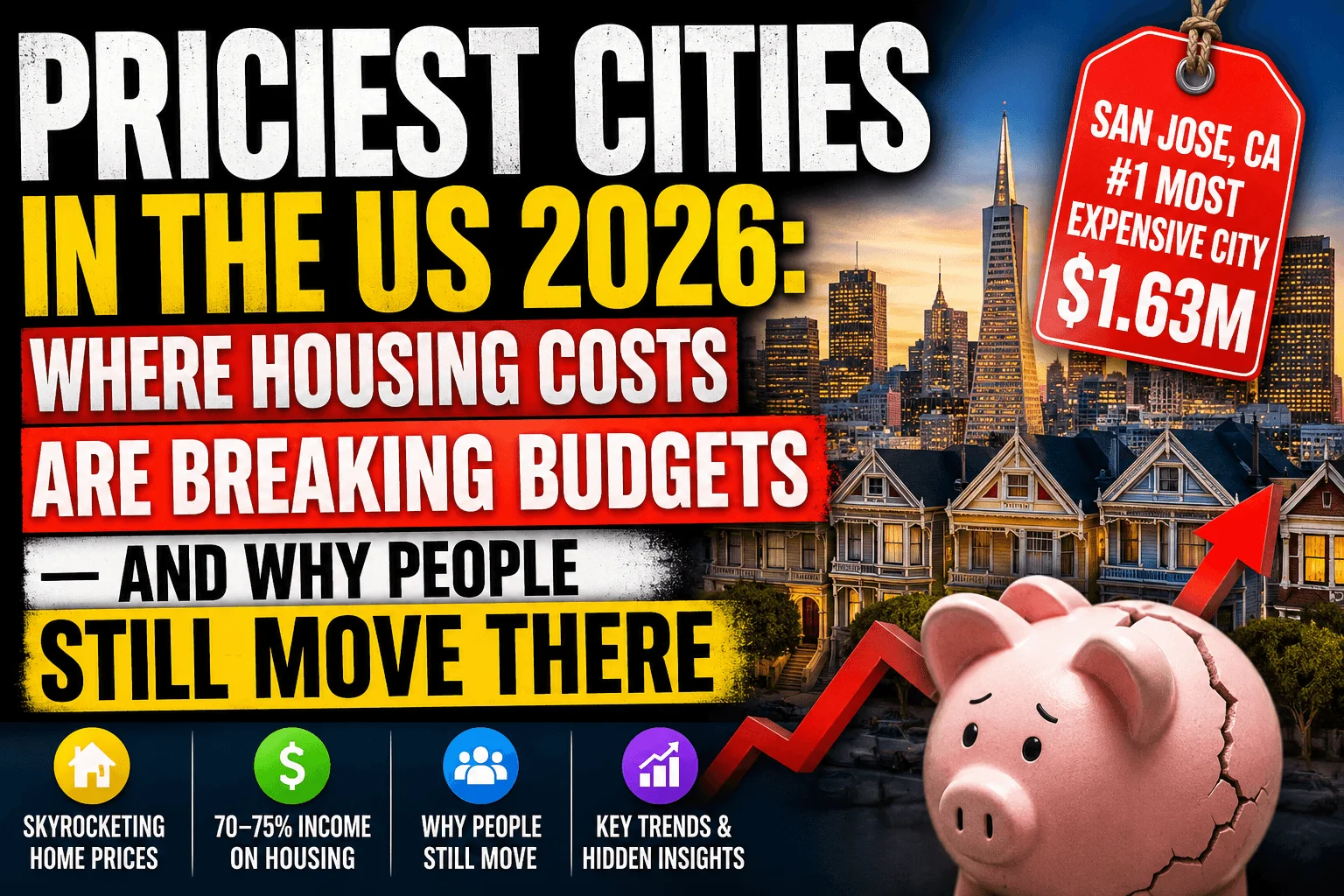
You crack open your laptop, type in a zip code and are looking at a six-figure home price that would have been considered impossible only ten years ago. Welcome to America’s housing reality. Not only are the most expensive cities in the US expensive, but they are transforming who is able to live where, reforming careers, and forcing millions of households to make vicious financial trade-offs.
The affordability of houses has turned out to be one of the features of the contemporary America. The median home price in the country has topped 400,000, and in the most expensive real estate markets of the country that is a paltry sum. In the metros along coastal areas, mortgage payments consume 60-75 percent of gross household income on a regular basis. The difference between the wage and the house prices is not narrowing down but rather expanding.
But the paradox here is that people continue to migrate there. The question of why, as well as its worthiness to do so, is precisely what is unpacked by this guide. You may be a real estate investor looking to buy for appreciation potential, a relocation seeker with career versus cost in mind, or just out of curiosity the most expensive housing markets in America, this is your ultimate guide.
|
|
|
|
|
|
|
|
|
|
|
|
 Quick Takeaways
 Most Expensive City: San Jose, CA — Median home price ~$1.63 million
 Average National Median Home Price: ~$412,000 (2026)
 Key Affordability Trend: Coastal metros require 70–75% of income for housing payments
 States Dominating Rankings: California, New York, Hawaii, Massachusetts, Washington
 Hidden Insight: Washington State residents earn the highest disposable income despite high costs
What Makes a City Expensive to Live In?
It is worthwhile to learn some of the structural forces that propel some metros into the stratosphere before getting into the list. There is an exceptionally similar group of drivers among the most expensive cities in the US.
Housing Prices & Supply Constraints
The largest lever with the greatest effect is limited buildable land. San Francisco is located on a peninsula of 7×7 miles. Manhattan is an island. The two cities have severe geographical limitations, which literally limit supply as demand explodes. This is magnified with stringent zoning laws, such as the height limit in San Francisco of 40 feet on the huge residential plots. When you cannot accumulate or extend, where to go but upwards?
- Boston commands the highest average price per square foot in the nation at $1,160/sq ft
- New York City follows at $1,106/sq ft, and San Francisco at $1,004/sq ft
- A $305,000 budget buys just 263 sq ft in Boston — barely a studio apartment
Cost of Living & Taxes
The story is more than just housing. The combined state and city income tax rates paid by residents in New York City are up to 14.8%. California has a state income tax rate of up to 13.3%. The grocery prices in Hawaii are 31-50% higher than the national average. It is these latent drainages that make costly cities in America even more draining than the rent bill itself hints.
Job Market & Foreign Investment
These cities are home to high-paying tech, finance and healthcare jobs – and capital around the world follows. New York, Miami, and San Francisco are not just domestic shelter markets, they are also internationally traded asset classes. The luxury U.S. real estate is seen as a safe-haven by foreign investors, establishing price floors that local wages are unable to match.
The Priciest Cities in the US in 2026
These are the conclusive list of the most expensive cities to live in America, ranked by median home price. These are the most expensive US cities that are influencing real estates discussions at the moment.
1. San Jose, CA — Median Home Price: ~$1.63 Million
The heart of Silicon Valley is on the first line of all lists of the most expensive cities in the US. With semiconductor powerhouses, AI startups, and engineering talent worldwide, San Jose has created an economy where earning a $200,000 salary is the norm, and still not enough to afford a home comfortably.
- Major Industries: Technology, semiconductors, AI, venture capital
- Monthly mortgage payment averages: $8,539vs $3,255 rent — a 162% buy-to-rent premium
- Lifestyle pros:World-class innovation ecosystem, mild climate, proximity to nature
- Lifestyle cons:Brutal commutes, extreme housing scarcity, cost-of-living pressure on mid-range earners
2. San Francisco, CA — Median Home Price: ~$1.4 Million
San Francisco is perhaps the world icon of housing inaffordability. It also symbolizes the contradiction of the most expensive cities in the US: the average monthly expenditure of the population on the basic bills is 3,205, but the city continues to draw the most ambitious talents in the world..
- Major Industries: Technology, finance, biotech, tourism
- Buy-to-rent ratio: 7%— the highest in the nation
- Lifestyle pros:Cultural richness, elite dining, Bay Area outdoor access
- Lifestyle cons:Astronomical rents, homelessness challenges, Prop 13 locking up supply
3. New York City, NY — Median Home Price: ~$850,000
The median price in New York appears to be average in comparison to California, however the median price per square foot in Manhattan of 1,106 is telling. Even a $100,000 salary in this area would be equivalent to only $31,000 after tax and living expenses are factored in – one of only two cities that would leave a six-figure earner in the red. NYC is one of the most expensive cities in the US, and it is only in this city that the wealth and deprivation are living side by side.
- Major Industries: Finance, media, fashion, healthcare, tech
- 3% of NYC residents are permanent renters — mathematically locked in by stabilized leases
- Lifestyle pros:Unmatched cultural capital, global career access, world-class transit
- Lifestyle cons:Highest combined income taxes in the US, extreme density, limited space for dollar spent
4. Honolulu, HI — Median Home Price: ~$900,000
Heaven is very expensive. The cost of housing in Honolulu is 199.1 per cent over the national average, and the city has a structural handicap that it shares with none of the mainland metros: just about all of its consumer goods have to be delivered by sea or air. Honolulu is the most expensive city in the US and its only city where the geography is the most significant factor that dictates the price, not the demand.
- Groceries run 31–50% above national average; utilities are 93–94% above mainland norms
- A family of four can spend over $1,000/month on food alone
- Lifestyle pros:Unrivaled natural beauty, year-round tropical climate, unique Pacific culture
- Lifestyle cons:Island isolation, supply chain premium on everything, lowest disposable income in the US at only $9,550/year
5. Boston, MA — Median Home Price: ~$800,000
- The city of Boston has a startling comparison: it is the most expensive per square foot of any large American metro at a price of 1,160. The supply expansion is almost impossible due to historical zoning restrictions which permit a maximum of 2.3 new units per 1,000 residents. The average resident expenditure on core bills is 3369/month- 64.6 percent higher than the national average. Boston is rightly ranked as one of the most expensive cities in the US.
Major Industries: Higher education, biotech, finance, healthcare
- Bill cost as a % of local household income: 57% — the highest ratio on the East Coast
- Lifestyle pros:World-class universities, rich history, strong job market
- Lifestyle cons:Extreme density, brutal winters, very low housing turnover
6. Los Angeles, CA — Median Home Price: ~$900,000
The sprawl of LA, which covers 469 square miles, produces a colossal price differentiation- ranging between 646/ sq ft of the average price in the city and 1,500/ sq ft in Beverly Hills. However, the 49.6 percent permanent renter rate in the city and average monthly bill of $2,859 that represents half of the median household income indicates why the City of Angels tops all the lists of the most expensive cities in the US.
- Major Industries: Entertainment, tech, fashion, healthcare, aerospace
- Lifestyle pros:Incredible diversity, entertainment access, global career network
- Lifestyle cons:Traffic, wildfire insurance crisis, severe wealth inequality
7. Seattle, WA — Median Home Price: ~$750,000
Seattle is a curious middle ground between the most expensive cities in the US. The state of Washington is in fact leading in the country in terms of disposable income, with a resident income of $30,893/year after expenses due to the lack of a state income tax. However, the buy-to-rent ratio in Seattle remains at 125 percent, and the pressure of Amazon, Microsoft and Boeing housing demand is still increasing.
- Major Industries: Technology, aerospace, retail (Amazon HQ), maritime
- Lifestyle pros:No state income tax, stunning Pacific Northwest scenery, outdoor culture
- Lifestyle cons:Rising home prices, grey winters, rapidly changing neighborhood character
8. Washington, D.C. — Median Home Price: ~$630,000
The State of Washington, D.C. has a land area of only 68 square miles but has 5.4 million daytime workers. Relentless housing demand is created by government, lobbying and through federal contracting. With an average of 473/ sq ft, it is larger than NYC or Boston, yet residents pay 3,106/month average core bills 34.3 higher than national averages. D.C. is able to establish itself as one of the most expensive cities in the US not due to technology affluence but through the institutional density.
- Major Industries: Federal government, defense, consulting, lobbying, healthcare
- Lifestyle pros:World-class museums (free), global networking, stable government-backed economy
- Lifestyle cons:Heavy political climate, high humidity, congestion
Comprehensive Comparison Table: Priciest Cities in the US
This table summarizes the key data of each of the most expensive cities in the US, which makes it possible to directly compare them in terms of affordability aspects.
|
City |
Median Home Price |
Median HH Income |
Affordability Score |
Major Industries |
CoL Rating |
|
San Jose, CA |
$1,630,000 |
$134,000 |
Very Low |
Tech, AI, Semiconductors |
|
|
San Francisco, CA |
$1,400,000 |
$126,000 |
Very Low |
Tech, Finance, Biotech |
|
|
Honolulu, HI |
$900,000 |
$85,000 |
Very Low |
Tourism, Military, Retail |
|
|
Los Angeles, CA |
$900,000 |
$73,000 |
Very Low |
Entertainment, Tech, Healthcare |
|
|
New York City, NY |
$850,000 |
$70,000 |
Very Low |
Finance, Media, Tech |
|
|
Boston, MA |
$800,000 |
$81,000 |
Low |
Biotech, Education, Finance |
|
|
Seattle, WA |
$750,000 |
$102,000 |
Low |
Tech, Aerospace, Retail |
|
|
Washington, D.C. |
$630,000 |
$90,000 |
Low |
Government, Defense, Consulting |
|

Why Are Coastal Cities So Expensive?
It is no coincidence that the coastal metros are the top in all the lists of the most expensive cities in the US. There are five forces which interlock to cause a pricing vortex which inland cities just do not experience.
- Limited land:Peninsulas, islands, and ocean barriers create a hard ceiling on supply
- High-paying jobs:Tech and finance cluster in coastal cities, pulling in high-earning talent who bid up housing
- Strict zoning:California’s Prop 13 and height limits effectively freeze supply while population grows
- Population pressure:Coastal metros absorb immigration both domestic and international simultaneously
- Foreign investment:Offshore wealth treats Bel Air, Fisher Island, and Manhattan as globally traded assets, not local housing
The result? Even small corrections in the most costly housing markets are likely to be temporary. A price change of 2 percent on a $1.4 million house will not rejuvenate affordability, it will only move off the hyper-growth curve to high-plateau stagnation.
Most Expensive vs Most Affordable US Cities: A Stark Contrast
To have a complete picture on the cost of living in the US, the extremities must be compared. The following is the list of the most priciest cities in the US compared to the cheapest markets.
|
City |
Median Home Price |
CoL vs National Avg |
Annual Disposable Income |
|
San Jose, CA |
$1,630,000 |
+195% |
~$28,000 |
|
San Francisco, CA |
$1,400,000 |
+185% |
~$23,790 |
|
Honolulu, HI |
$900,000 |
+199% |
$9,550 |
|
Memphis, TN |
$165,000 |
-18% |
~$38,000 |
|
Cleveland, OH |
$130,000 |
-22% |
~$35,000 |
|
Detroit, MI |
$90,000 |
-28% |
~$30,000 |
|
Huntsville, AL |
$400,000 |
+5% |
~$42,000 |
|
Carmel, IN |
$390,000 |
+2% |
~$48,000 |
The difference is startling: the most priciest cities in the US demand a salary of between 120,000 and 138,000 to live comfortably as a single adult, and similar quality of life is attained on a half that amount in affordable Midwest markets.
Is Living in an Expensive City Worth It?
This is what all relocation seekers struggle with. The real answer: it is all a matter of your stage of career, your tolerance of risks, and your own values. Here are the thoughts to go through the most priciest cities in the US.
Career Opportunities
Tier-one cities provide access that can not be matched by any low-cost city. The compactness of decision-makers in San Francisco, New York, and Boston brings about career acceleration effects – particularly during the initial ten years of a career. In the case that your industry will respond to distance and connection making, even the most priciest cities in the US. can be a payoff more than the cost penalty.
Appreciation Potential
The highest-valued real estate markets in history have been able to provide disproportionate appreciation. The values of homes in San Francisco increased by more than 300 percent in the period between 2000 and 2022. But the same appreciation also implies that you require much more capitals to be part of it, and the timing and financing scheme is very important to investors.
Financial Trade-offs
Math can be mean. In Manhattan a $100,000 salary will purchase 31,000 of good buying power. In San Jose, 35 percent of median household income, regardless of rent or mortgage, is taken up by monthly bill expenses. The most priciest cities in the US reward those who can earn well and punish everyone as well.
- High earner (>$200K/yr):Financial trade-offs are manageable; appreciation upside is real
- Mid-range earner ($80K–$150K):Extreme financial stress; quality of life often erodes over time
- Early career:Strategic 3–5 year play for skill-building; plan an exit before lifestyle inflation locks you in
Expert Tips Before Moving to a High-Cost City
If you’re considering a move to one of the priciest cities in the US, go in with eyes open and a clear strategy.
- Calculate your true disposable income,not just salary. Subtract state/city income tax, housing, bills, and transportation before accepting any offer.
- Research the buy-to-rent ratio.In SF and San Jose, renting is often the financially smarter short-term choice given the 162–181% premium to own.
- Target affordable micro-neighborhoods.Every expensive city has price variation. Oakland vs SF, Jersey City vs Manhattan — location arbitrage within metros is real.
- Negotiate remote work flexibility.Even two days remote per week opens up more affordable suburbs and slashes commute costs.
- Build an exit strategy from Day 1.Set a 5-year savings target. Residents who don’t plan ahead find themselves priced out of even nearby affordable markets after years of coastal burn rates.
- Explore employer housing programs.Some tech companies offer down payment assistance or housing stipends — always ask during negotiation.
- Watch for demographic overflow opportunities.Markets like Bridgeport CT, Fresno CA, and Colorado Springs CO are absorbing coastal refugees — and seeing rapid appreciation. These secondary markets offer growth potential without the primary-city price tag.
|
|
|
To live comfortably as a single person in 2026, you need to earn: |
|
$138,570/year in New York City |
|
$136,739/year in San Jose |
|
$119,558/year in San Francisco |
|
vs. $75,088/year in Houston, TX |
Frequently Asked Questions: Priciest Cities in the US
Q1: What is the single most expensive city to live in the US in 2026?
San Jose, California, is the highest ranked with a median home price of about 1.63 million and hence the most extreme of the most expensive cities in the US. Its preeminence as the center of Silicon Valley contributes to unprecedented real estate prices.
Q2: Why are California cities so dominant in rankings of priciest cities in the US?
California is a mixture of limited construction areas, the largest tech-based economy in the world, stringent zoning and height restrictions, California Proposition 13 (which makes it hard to sell properties), and huge foreign investment. The consequence is an ideal storm of low supply and insatiable demand.
Q3: Are median home prices the best way to measure expensive real estate markets?
Home prices are median, but the price per square foot is a more truthful story. The Real total of Boston is more than that of San Francisco by a margin of 1,160/ sq ft and can be argued that it is the most space-prohibitive one. The most expensive cities in the US appear as various by which measure to go.
Q4: Is it cheaper to rent than to buy in expensive cities in America?
In almost all coastal metros. The monthly mortgage payment is averaged at 8,486 in San Francisco compared to 3,024 to rent a home, 180.7 percent higher to own. In San Jose, it’s a 162.3% gap. In the majority of the most expensive US cities renting is the economically reasonable short-term decision.
Q5: Which expensive US city offers the best financial value for high earners?
Seattle stands out. The absence of state income tax in Washington State implies that high income earners will have much higher pay in their hands as compared to California or New York. Although the city is among the most expensive in the US, Washington State is the highest in the country with a disposable income of $30,893/year after expenses.
Q6: What salary do you need to live comfortably in New York City?
In 2026, one adult will have to earn about 138,570 per year to stay in a comfortable environment in the city of New York. But, once taxes and cost-of-living correction are applied, a $100,000 salary has a purchasing power of around only $31,000, and NYC is one of the most punishing of the most expensive US cities to be a middle-income earner.
Q7: Are there affordable alternatives near the priciest cities in the US?
Yes. Population explosion is forming secondary markets with rapid growth. The Bridgeport, CT (near NYC) has experienced a growth of 12.35% per year. Oakland is much less expensive than San Francisco. Jersey City provides access to Manhattan at a cheaper price. Affordable cities in America have an advantage of growth in these markets.
Q8: How does Hawaii compare to mainland expensive cities in America?
Hawaii is special: it is isolated, which translates to nearly all the products being imported, driving grocery prices 31-50 percent higher than the national levels and utility prices 93-94 percent higher. Although its disposable income is among the lowest in the country (9,550/year in Hawaii), Honolulu is among the most expensive cities in the US because of the cost of housing, as well as, the premium of logistical isolation.
Q9: Is real estate in the priciest cities in the US a good long-term investment?
Yes, in the past, but with conditions. Markets in the expensive real estate of the coast have been experiencing robust growth of appreciation – yet the high rates of interest, the insurance crisis (in particular LA and Miami) and exodus of population are blowing the wind against it. The highest of the housing markets are moving to a high plateau stage and not hyper-growth.
Q10: What are the most expensive ZIP codes in the US?
The median list price of Fisher Island in Miami (33109) is 12.45 million. The median in Bel Air (90077), Los Angeles is 9.85 million with a list of up to 177 million. Bridgehampton NY (11932) median is of 8.77 million. These micro-markets symbolize the very highest point of the most expensive cities in the US as the global capital dictates the minimum price.


Join The Discussion