

Your homeowner’s association levies a fine against you because of the improper color paint on your walls, a satellite dish on your roof, or an American flag on your lawn. Before you part ways with your hard-earned money, ask yourself one simple question. Is this rule legally valid? Most times, it won’t be. Certain homeowner’s association rules are nullified immediately by federal laws, state laws, and/or the procedures within the organization.

What makes an HOA rule unenforceable?
Courts apply a simple three-test check to decide whether a rule holds up:
- Does it conflict with federal or state law? If yes, the rule is void—no matter what your CC&Rs say.
- Was it adopted properly? Boards must follow notice, quorum, and voting requirements set out in the bylaws.
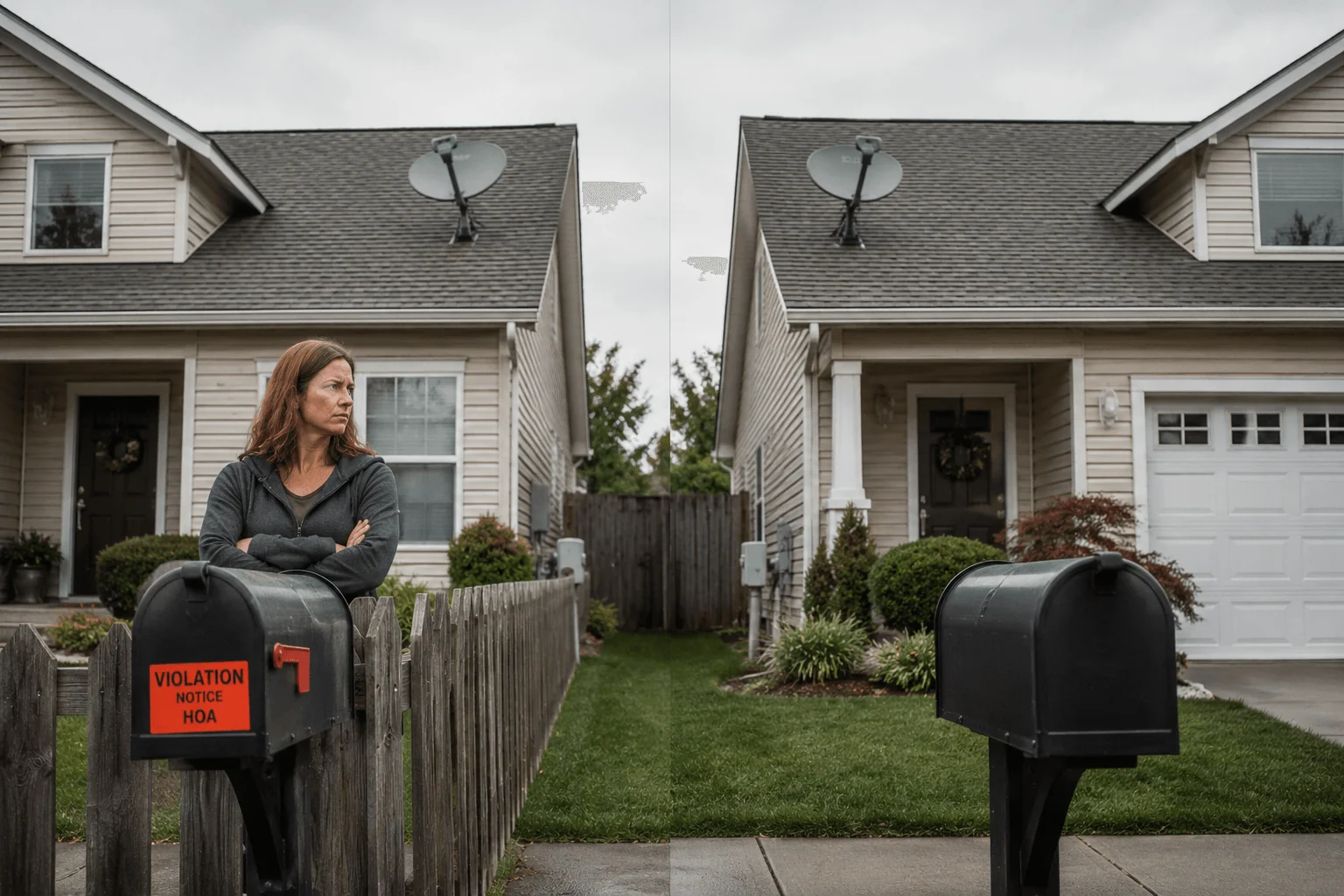
- Is it enforced equally? A rule applied to you but ignored for your neighbor invites a legal challenge.
Fail any one of these, and a court will likely throw the rule out.

Where HOA rules rank in the legal hierarchy
Not all HOA documents carry equal weight. They follow a strict chain of authority:
- Federal law and the Constitution sit at the top.
- State statutes and local ordinances come next.
- The Declaration (CC&Rs) is the recorded foundation that runs with your land.
- Bylaws govern operations like elections and meetings.
- Board-adopted rules rank last—and are the most vulnerable.
Here’s the key point most boards gloss over: a board can’t invent a new property-use restriction by passing a quick resolution. If the authority isn’t in the recorded CC&Rs, the rule likely can’t stand. Always ask your board to point to the exact provision that backs up any violation notice.

Federal laws that void HOA rules
Several federal statutes override community rules across the country:
- Fair Housing Act: Bans discrimination based on race, religion, disability, familial status, and more. Strict occupancy caps, adults-only pool hours, and “no emotional support animal” policies often violate it. Violations can trigger fines from $20,000 to $100,000—plus personal liability for board members.
- FCC OTARD Rule: Blanket bans on satellite dishes under one meter are preempted. You can install one in areas under your exclusive use, like a private patio.
- Freedom to Display the American Flag Act (2005): No HOA can ban the U.S. flag outright, though reasonable size and placement limits are allowed.
- Americans with Disabilities Act: Applies to common areas open to the public, like clubhouses that host public events.
- Fair Debt Collection Practices Act: Limits aggressive tactics when associations chase unpaid dues and fines.
State laws that protect homeowners
State statutes often go further than federal law. Three of the most active states show the range:
- California (Davis-Stirling Act): Civil Code § 4740 blocks retroactive short-term rental bans. The case Brown v. Montage at Mission Hills confirmed existing owners are grandfathered in when new rental restrictions pass.
- Florida (Chapters 720 and 718): Procedure is everything. Boards must give 14 days’ notice and offer a hearing before a panel of three impartial members. Fines are capped at $100 per day, up to $1,000 total, unless the CC&Rs say otherwise.
- Texas (Property Code): Associations can’t ban solar panels, drought-resistant landscaping, religious displays, or the U.S. and Texas flags.

Legal defenses homeowners can use
When a rule fails the fairness test, courts recognize several affirmative defenses:
- Selective enforcement: The HOA fines you but ignores identical violations next door. You must show a sustained pattern of unequal treatment, not just one stray example.
- Equitable estoppel: You relied on the board’s word—say, a verbal approval—and spent money before they reversed course.
- Laches: The board knew about a violation but waited so long to act that enforcing it now would unfairly harm you.
- Waiver or abandonment: A rule ignored for years across many homes is legally dead until the board formally readopts it.
The money at stake
Enforcement issues are based on dollars. In many state statutes and CC&Rs, the issue of attorney’s fees is dealt with through “loser pays” provisions, where the prevailing party gets his or her fees from the other side. This was evident in the Ritter & Ritter v. Churchill Condominium Assn. Case in California, where a condominium association was ordered to pay almost $550,000 of attorneys’ fees.
How to challenge an HOA rule, step by step
- Document the pattern. Take date-stamped photos of similar violations the board ignored.
- Request records. Demand violation logs, fine schedules, and meeting minutes for a specific timeframe. In California, an unjustified denial can expose the HOA to penalties under Civil Code § 5235.
- Submit a written defense. Cite the exact statute or CC&R provision the rule violates, and attach your evidence.
- Send a cease and desist if needed. When a board acts far outside its authority, a formal letter setting a deadline puts them on notice before litigation.
What homeowners support—and what they resent
It can be seen from the survey results that there is an interesting dichotomy between the residents of the HOA. A vast majority approve the rules against disturbances in the community: 79% are in favor of controlling the noise, 70% believe there should be control over garbage and 67% think there needs to be control over the cars.
Problems arise once the regulation becomes more personal in nature. A majority of people are either opposed to or skeptical about regulation regarding renovations (67%), pet owning (59%) and paint color choice (54%).
Your next move
The HOA fines do not necessarily constitute an end judgment. Look up your governing documents, compare the rule to the three-part test, and have the board assert its jurisdiction. Document the process and consider seeking legal counsel who specializes in community association law in your state. Those regulations which you believe to be the most unreasonable may often be among the easiest to challenge successfully.
Frequently asked questions
Can my HOA ban satellite dishes?
No. The FCC’s OTARD rule preempts blanket bans on dishes under one meter installed in areas under your exclusive use, such as a private balcony or backyard.
What should I do if my HOA enforces a rule unequally?
Document the ignored violations with date-stamped photos, request the association’s enforcement records, and raise selective enforcement as a defense in writing.
Are HOA fines limited by law?
In some states, yes. Florida caps fines at $100 per day and $1,000 total unless the governing documents allow more. Other states leave caps to the CC&Rs.
Who pays legal fees in an HOA dispute?
Many state laws and CC&Rs include fee-shifting clauses, so the losing party often covers the winner’s attorney’s fees—a major reason boards avoid weak enforcement cases.


Join The Discussion