

Property tax and real estate tax are actually the same thing. This type of taxation applies to your property such as your house, land, or rentals. While the IRS prefers the use of the term “real estate tax,” the term that is more popularly used by many people is “property tax.”
Ever got confused looking at your tax forms or mortgage papers? Well, don’t worry; the terms “property tax” and “real estate tax” are often used interchangeably even if they are actually different terms! Let’s find out what those terms really mean.
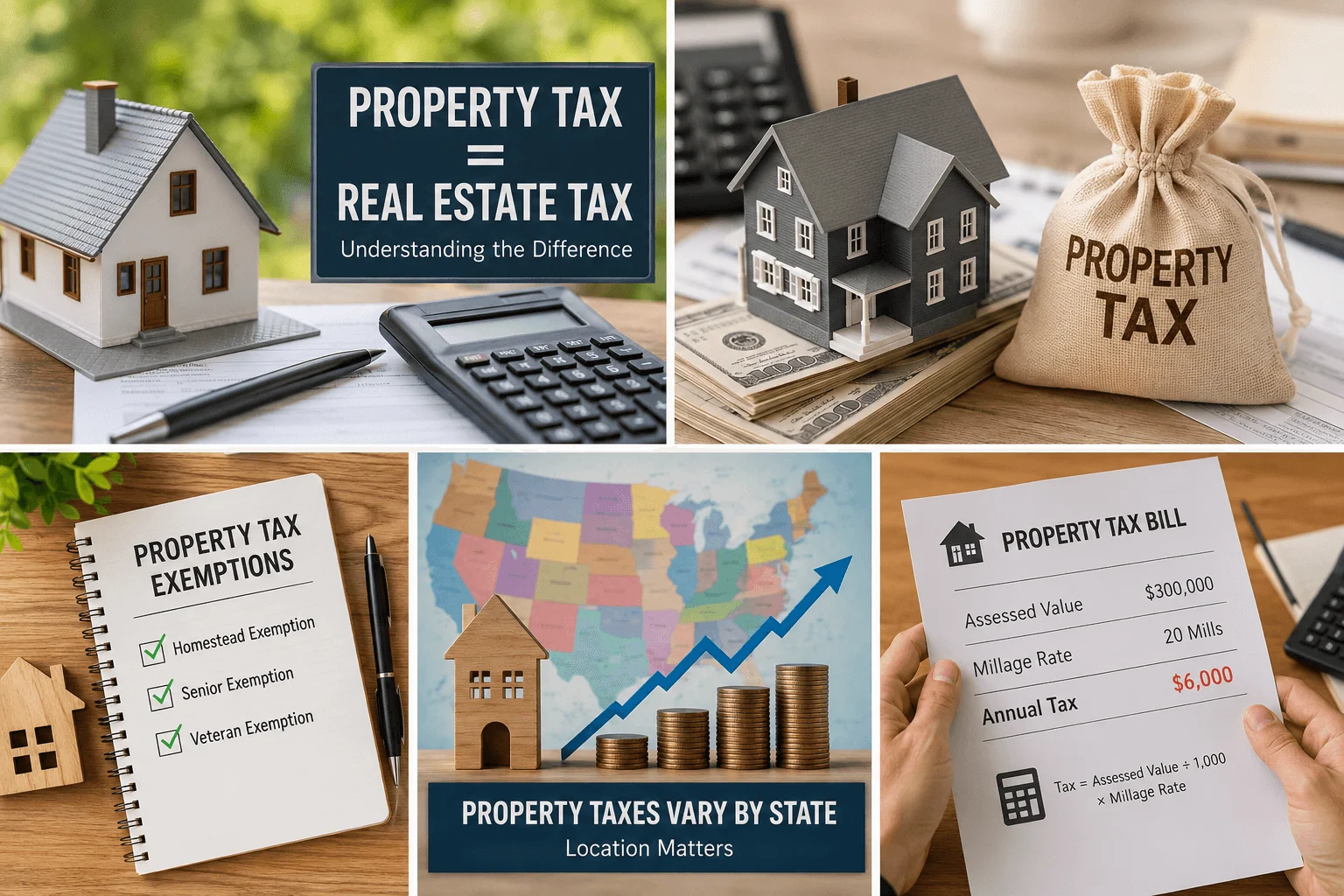
Are property tax and real estate tax actually different?
So here is the quick answer: in most cases, both these terms refer to the same tax. According to TurboTax, real estate tax and property tax are the same; the only difference is that the Internal Revenue Service uses the term “real estate tax,” while the common people call it “property tax.”
However, one little twist should be taken into account. “Property tax” may be viewed as a broader term than “real estate tax.”
What is real estate tax?
Real estate tax is basically a tax on real property such as houses, condominiums, plots, and even buildings used for renting out. The taxes will pay for services provided by your state or city government. This includes your local school district, road maintenance, firefighting, and library. “Real estate taxes,” as H&R Block states, are taxes on real property in the United States.
Here the term “real” means immovable property. Your home is not moving, thus it is considered real estate.

What is property tax?
And now it gets really interesting! Property tax may be the same as real estate tax but may also mean personal property tax, which is a different tax on movable property.
Some examples of personal property are automobiles, vessels, airplanes, trailers, and mobile homes. As indicated at the H&R Block site, the categories of personal property that may be taxed are different in various jurisdictions. In certain states, you will have to pay for both real estate and personal property taxes.
In short, real estate taxes are always property taxes, but property taxes are not necessarily real estate taxes.
How are property taxes assessed?
Wanna know how much you pay in taxes? In general, there are two factors which decide your property taxes: the value of your property, and the rate set by the taxing authority.
The rate is called a “millage rate.” As per the Florida Department of Revenue, one mill would cost you $1 of tax for every $1,000 of the assessed value. So, in case your property is assessed at $300,000 and the millage rate is 20 mills, you will pay approximately $6,000 in taxes.
Counties, cities, and school districts set these millage rates, along with doing assessments of properties. That is why two similar properties from two different cities would have very different tax bills.
Why do property taxes vary so much by state?
Your location really matters! The variation in property tax rates is quite significant.
As per the Tax Foundation, the highest property tax rate exists in New Jersey, followed by Illinois and Connecticut. On the other hand, according to Kiplinger, the lowest property tax rates can be found in Hawaii, Idaho, and Wyoming.
It becomes quite important if you are looking to buy a home or relocate from one place to another. In many cases, buying an expensive house from a low-tax region is cheaper than buying an inexpensive house in a high-tax region.
What exemptions can lower your property tax bill?
Good news—you might not have to pay the full amount! Many states offer exemptions that shrink your taxable value:
- Homestead exemptions reduce the taxable value of your primary residence.
- Senior citizen exemptions offer relief for older homeowners, like Ohio’s statewide program for those who qualify.
- Veteran and disability exemptions can be substantial. Georgia, for example, granted qualifying disabled veterans an exemption of up to $121,812 for 2025.
These programs vary by state and often require you to apply, so it pays to check what’s available in your area.
What this means for homeowners, buyers, and investors
If you already own your home, or if you are considering buying one, below is how you can apply this information.
For current homeowners: Examine your tax statement thoroughly to find out if there are any personal property taxes included in it. Moreover, investigate all exemptions that you may be eligible for, such as a homestead or senior exemption.
For prospective buyers: Do your homework before signing on the dotted line. Request tax records of the property, consider annual tax in your budget, and compare tax rates among neighborhoods. Same price houses may have very different costs in the long run.
For real estate professionals: The clear guidance on taxes helps build credibility. Showing clients the difference between real estate taxes and personal property taxes and guiding them about any local exemptions makes you a genuine expert.

Clearing up the property tax puzzle
So, is there any difference between property tax and real estate tax? Yes and no, for the most part. If you’re a homeowner, both terms refer to the tax you pay on your house and lot. However, just be careful, because property tax may also apply to personal property such as cars and boats.
Now that you have learned about the distinction, you can easily understand your tax bill, make a well-thought budget plan, and ensure that you get all the exemptions you deserve. What should be done next? Research on the tax rate and exemptions in your locality.
Frequently asked questions
Is real estate tax deductible on my federal return?
Real estate taxes paid on your home may be deductible if you itemize, subject to IRS limits. Check current IRS rules or speak with a tax professional, since deduction caps and eligibility can change.
Does property tax include personal property like my car?
It can. In some states, “property tax” covers both real estate and personal property such as cars, boats, and mobile homes. Real estate tax, by contrast, applies only to fixed property like your home or land.
Which state has the lowest property taxes?
According to Kiplinger, Hawaii ranks among the states with the lowest property tax rates, followed by Idaho and Wyoming. Rates can change yearly, so confirm current figures for your specific area.
Who decides how much property tax I pay?
Local jurisdictions—counties, cities, and school districts—set tax rates and assess property values. Your bill depends on your home’s assessed value multiplied by the local millage rate.
Can I lower my property tax bill?
Yes! Many states offer exemptions for homeowners, seniors, veterans, and people with disabilities. You usually need to apply, so check your local tax authority for available programs.


Join The Discussion