
Table of Contents
Key Takeaways :
- ✅ Test the well water for arsenic, radon, and PFAS
- ✅ Shop for a fixed-rate electricity contract before winter
- ✅ Confirm broadband availability at the specific address
- ✅ Look up the town’s exact property tax millage rate
- ✅ Research nearby hospital services, especially if you’re planning a family
- ✅ Attend a town meeting — just to see how local governance actually works
New Hampshire is the favorite of real estate blogs. No income tax! Stunning fall foliage! Low crime! White Mountains!
And all that is true. None of it is the whole picture.
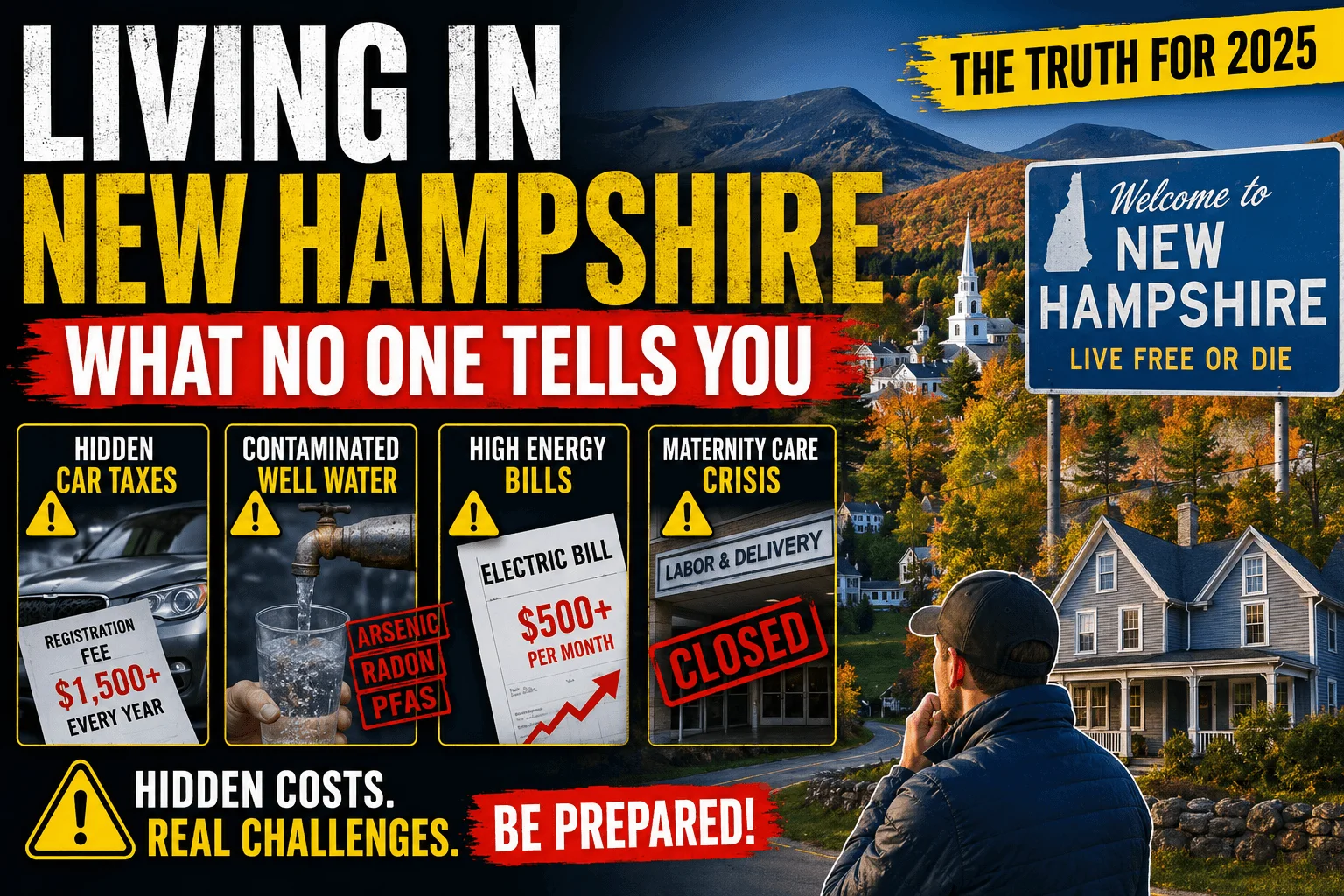
What these articles do not report is here—the unseen taxes on vehicles, the polluted well water, the disappearance of maternity wards, and a political movement that is silently transforming local town meetings.
Read this first in case you are considering moving to New Hampshire.

1. The “Tax-Free” Myth: Hidden Vehicle Registration Fees
The pitch of no-income-tax, no-sales-tax is outrageous. It will be–but there’s a financial surprise awaiting you at your town clerk,s office.
New Hampshire imposes an annual vehicle registration fee on the basis of the original MSRP of your car – it is not what you paid, not what it is worth now.
Here’s how it works:
Vehicle Age | Fee Rate | Cost on a $50,000 Car |
|---|---|---|
Year 1 | 1.8% of MSRP | $900 |
Year 2 | 1.5% | $750 |
Year 3 | 1.2% | $600 |
Year 4 | 0.9% | $450 |
Year 5 | 0.6% | $300 |
Year 6+ | 0.3% | $150 |
Impose state weight-based plate fees (31 to 55), a $100 EV surcharge, document fees and title fees.
A house with two cars can afford to spend $1,500-2000 annually to register their cars. That is compared to Massachusetts, which is a flat fee of $60 to register.
Summary: With the tax system in NH, high-earners who own humble property are big winners. Newer cars, middle-class families with a home worth 600K? The mathematics may not seem as different as you would think between Massachusetts and the rest of the state.

2. What’s Really in Your Well Water
Approximately, 46 percent of households in New Hampshire obtain their drinking water by using the private wells. Almost half the state of that–and a great many of those wells are not all right.
The Three Big Threats
Arsenic
- Naturally leaches from New Hampshire’s granite bedrock
- ~30% of tested private wells exceed NH’s own safety limit of 5 ppb
- Colorless, tasteless, odorless — you won’t know it’s there
- Long-term exposure is linked to bladder, lung, and skin cancers
Radon
- Also produced by granite bedrock
- Off-gasses from well water into your home — especially in basements and bathrooms
- Second-leading cause of lung cancer in the U.S.
PFAS (“Forever Chemicals”)
- Contamination traced to industrial sites and former military bases like Pease Air Force Base
- 27% of tested wells exceed NH’s safety standards
- Linked to immune suppression, reproductive issues, and cancer
Standard home inspections don’t test for these. You have to ask — and pay — for a full panel.
What It Costs to Fix
- Arsenic filtration system: $1,500–$3,000
- PFAS reverse osmosis or carbon filtration: $3,000–$5,000+
- Radon aeration system: add several hundred to a few thousand more
NH does have rebates up to 10,000 on PFAS remediation- however the process of the rebates is sluggish. Budget upfront.

3. Why Your Electric Bill Will Shock You
New Hampshire is the sixth highest in the country in terms of residential electricity rates.
- National average: 17.47¢ per kWh
- New England average: 29.24¢ per kWh — that’s 67% higher
- Eversource NH recently raised its monthly base charge to nearly $20/month
Why It’s So Expensive
It is not greed it is geography. New Hampshire is at the terminal end of the natural gas pipeline system within the country. There is short supply, particularly during winter.
In the cold weather, heating of homes has a legal precedence over power production.
The utilities are compelled to purchase gas in the spot market at a high price. Regional generators were paying $14.62 per MMBtu in February 2025 – compared to a national average of only $3.37.
What You Can Do
New Hampshire has deregulated electricity market. It would be possible to shop third-party energy suppliers and sign a fixed rate of 1236 months.
Shop before winter. It is among the most suitable financial decisions any new NH resident can make.

4. Rural Broadband: The Hidden Remote Work Risk
New Hampshire ranks second nationally for overall internet coverage — but that number hides a massive gap.
- Coos County: Only 70% of homes have 100+ Mbps speeds
- Rockingham County: 99.8% coverage
- In Coos, Sullivan, and Grafton counties: up to 13–14% of households have no internet at all
Rural fiber is not being invested in by ISPs due to the lack of density to make these investments profitable.
The state is developing broadband – a project that aims to cover 48,000+ unserved addresses in 115 towns, however, it will take a long time to be built.
Fiber build-out dates and ISP availability Before falling in love with a rural property, check fiber build-out dates and ISP availability. A nice view won’t do you any good when you are unable to participate in a Zoom meeting.

5. The Maternity Care Crisis No One Mentions
There have been nine permanent closures of labor and delivery units in rural New Hampshire hospitals since 2000.
There are just five birthing hospitals still in operation in the state.
Why It’s Happening
- Declining birth rates = lower patient volume
- High share of Medicaid deliveries, which reimburse below cost
- Rural hospitals can’t recruit or retain OB specialists
What It Means for Families
A study by the Urban Institute revealed that driving time to the closest delivery hospital within the impacted areas has increased more than twice.
To families in northern, central, or western NH – this is not a statistic. It is a real-life risk.
The reality is that during a winter emergency, an hour-long drive along the icy mountain roads to access obstetric care is a reality.
6. New Hampshire Has Six Seasons, Not Four
Each real estate article boasts of four beautiful seasons. Ask any Granite Stater – there are six.
Stick Season (Late October – Early December)
- Foliage is gone. Snow hasn’t arrived.
- Trees are bare. Sky is gray. Days are short.
- Tourist dollars vanish. Local restaurants close for a break.
- Known trigger for Seasonal Affective Disorder among transplants
- Not a brief transition — it lasts weeks
Mud Season (March – May)
- Snowpack melts faster than frozen ground can drain it
- Dirt roads turn into deep, rutted mud pits
- Sedans get stuck. Trails close statewide.
- All-wheel drive is not optional in rural and semi-rural areas
Being aware of these seasons is what will make a prepared move to become a miserable first year.
7. The Boston Commuter Belt and Tax Math
Approximately 15 percent of the total working NH residents work outside the state – the majority of them across to Massachusetts.
Salem, Windham, Nashua, Hudson and Pelham are towns along I-93 and Route 3, and the bidding wars are intense.
The Interstate Tax Breakdown
- 100% remote worker employed by a MA company, living in NH: $0 income tax to either state
- Hybrid worker (2 days in Boston, 3 days remote): MA only taxes income earned on physical in-state days — potentially cutting your MA tax bill by 60%
The rates of property tax are insane in the towns–less than fifteen hundred dollars to the thousand in appraised value, and over twenty-five hundred dollars to the thousand.
Never use the average rate of the county, but that of the town.
8. The Housing Shortage Is Real — and It’s Manufactured
New Hampshire is deficient in housing units by about 25,000. The median home values across the state have been increasing to around 600,000.
This is not supply and demand. A large reason is the local zoning rules.
- Multi-family buildings (5+ units): permitted on just 46.5% of buildable land
- Lots under one acre: allowed on only 13% of buildable land
- ADUs: technically legal statewide, but ~50% of land requires two off-street parking spots — a major barrier in practice
In 2025, the state legislature enacted housing reform laws that will relax density controls and widen ADU rights. In late 2025, Manchester had a significant zoning changeover. The development is objective, but gradual.
9. The Free State Project and ‘Flatlander’ Tension
It is a life experience because living in New Hampshire plunges into a political environment unrelated to any other state in the United States.
In 2001, the Free State Project, a movement, planned to bring 20,000 libertarian activists to New Hampshire, specifically to transform local government. Over 10,000 are already relocated.
NH local budgets are determined at Town Meetings, which can be attended by anyone who turns up, so small organized groups can turn the tide.
In 2022, an organizer with Free State affiliations applied a low-attendance town meeting in Croydon to reduce the school budget in that town by half -by cutting from $1.7 million to $800,000. It was reversed in a special election as a result of community backlash, but the incident was national news.
Then there is the term Flatlander- any one who comes in to the south out of more urbanized states. It’s partly a joke. It is also a factual indicator of cultural rubbing.
The long-term residents tend to believe the newcomers inflate the prices of homes, seal off the available land and demand high-cost municipal amenities yet want taxes to remain low.
You do not need to choose one political party or another – but you ought to enter with your eyes close.
FAQ: Living in New Hampshire
1. Does New Hampshire really have no income tax?
Yes – there is not a wide tax on earned wages or salaries. Previously, investment income and dividends were taxed, but this was phased off by 2025. There’s also no state sales tax.
2. What’s the catch with New Hampshire’s taxes?
The property tax is also one of the highest in the state, with the average effective rate of property tax being about 1.86 at the state level – and that differs significantly per town. Newcomers are also surprised at the vehicle registration fees, which are computed based on MSRP.
3. Is well water safe in New Hampshire?
Not automatically. About 46% of residents use private wells. Contamination of arsenic, radon, and PFAS is prevalent and severe. Always check prior to purchase, and plan to filter in the event of contaminants.
4. Why is electricity so expensive in New Hampshire?
New Hampshire is at the terminus of the natural gas pipeline system. During winter, power stations and home heating systems fight over the scarce gas supplies, which increases wholesale electricity prices. The average rates are 23-28 cents per kilowatt hour – much higher than the national average.
5. Can I work remotely from New Hampshire for a Massachusetts company without paying Massachusetts income tax?
Yes. Considering you are a 100 percent telecommuter in New Hampshire, you would not pay any income tax to either the two states. Only when hybrid workers physically work in Massachusetts, they are taxed on those days.


Join The Discussion