

Table of Contents
Key Takeaways for Buyers:
Request full HVAC service history and dehumidification specs.
Commission a mold and moisture inspection before closing.
Review the property’s drainage grade and vapor barrier status.
Confirm flood zone designation and insurance availability.
Budget a humidity-adjusted maintenance reserve of 1.5%–2% of the home value annually.
In the U, the most humid cities can be found by searching:C, cold snowy Alaskan cities can be found on the list too often. Makes no sense to anybody who has ever lived in the South.
The fact is that the real Most Humid Cities in the U.S located along the Gulf coast and throughout Florida. You would like to find out the facts of the Most Humid Cities in the U.S, it is dew point that you should consider, not relative humidity.
This guide reveals the weaknesses of the majority of the lists of the most humid cities in the U.S and demonstrates to you what high moisture really means to your home, health and wallet.

Why Lists of the Most Humid Cities in the U.S Get It Wrong
There is nearly no article in which I did not mention the Most Humid Cities in the U.S employs an extremely abused measure: relative humidity.
Relative humidity merely is the amount of moisture within the air in comparison to the maximum quantity that could be held by the air at that temperature.
The twist is that cold air has low level of moisture. Thus, even bone dry Alaskan air would indicate a 79 percent relative humidity with just a little water vapor in the air.
This is precisely why Juneau, Alaska, a city that receives almost 90 inches of snowfall annually, will frequently be listed as the falsely crowned Most Humid Cities in the U.S. In case you need the real Most Humid Cities in the U.S, you need to get rid of relative humidity and adopt a superior measure.

The Metric That Defines the Most Humid Cities in the U.S
The temperature at which moisture must be condensed by air to cool is termed as the dew point. In contrast to relative humidity, dew point follows the real, physical moisture present in the air and is always in perfect line with how uncomfortable you feel.
In your assessment of the Humidest Cities in the U.The data is in full agreement with real-life experience with the use of dew point.
Here is how dew point translates to how the air actually feels:
Below 55°F: Dry and comfortable
55°F–60°F: Noticeable, but manageable
60°F–65°F: Sticky and humid
Above 70°F: Sweat stops evaporating; heat stress begins
Above 75°F: Oppressive and genuinely dangerous
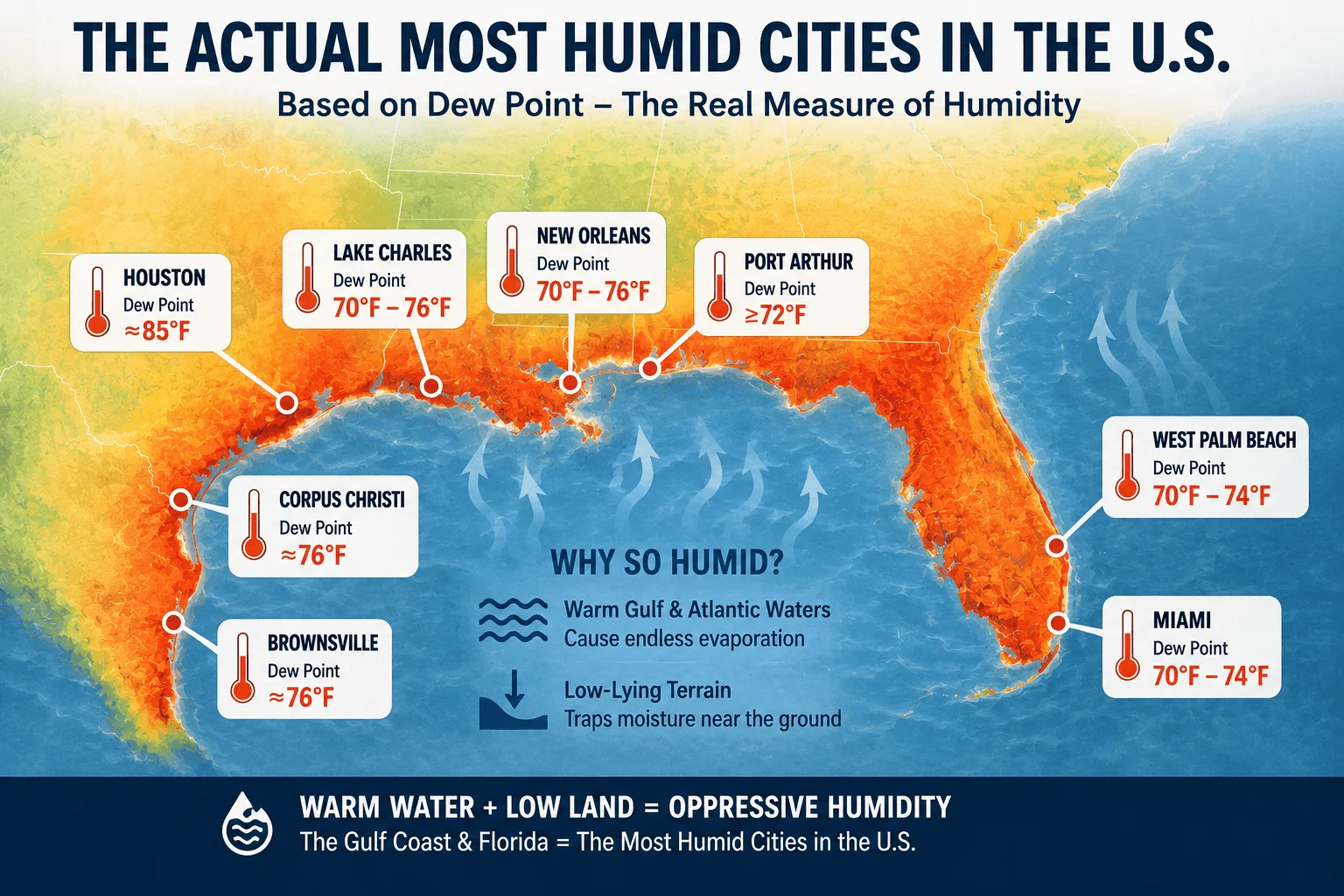
Revealing the Actual Most Humid Cities in the U.S
Based on dew point, the muggiest cities are concentrated squarely along the Gulf Coast and the Florida peninsula. These are the unquestionable Most Humid Cities in the U.S.
New Orleans, Louisiana: Sitting below sea level and hugging the Gulf of Mexico, it produces summer dew points of 70°F–76°F.
Lake Charles, Louisiana & Port Arthur, Texas: Locals compare summer to living inside a heated sauna, with dew points regularly topping 72°F.
Houston, Texas: Averages 85°F in summer with nearly 100 days a year above 90°F. The sprawling concrete traps heat, making it one of the most oppressive Most Humid Cities in the U.S.
Miami and West Palm Beach, Florida: Wrapped by warm water on three sides, these cities face a year-round moisture burden.
Corpus Christi and Brownsville, Texas: Constant Gulf moisture creates relentless summer humidity averaging 76% daily.
The unifying factor of the Most Humid Cities in the U.S is geography of warm water.
Endless evaporation is caused by the warm Atlantic currents of the Gulf of Mexico and the low terrain traps that trap the moisture near the ground.

How “Corn Sweat” Spikes Humidity Outside the Most Humid Cities in the U.S
The American Midwest is never considered one of the Most Humid Cities in the U.S year-round, with some of the highest short-term spikes nationally.
In the growing season when there is a lot of growth, corn and soybean crops in Iowa, Illinois, Nebraska, and Wisconsin emit huge volumes of water vapor via their leaves. Scientists refer to it as evapotranspiration, yet all the rest refer to it as corn sweat.
The extent of this is frightening. One acre of full-grown corn has the capability of transpiring as much as 4,000 gallons of water in a day. Iowa by itself cultivates about 13.5 million acres of corn, spewing tens of billions of gallons of vapour into the atmosphere per day.
This agricultural moisture can even skyrocket dew points in cities such as Chicago and Green Bay under the heat domes of summer to levels akin to the deep South.
Indeed, the largest dew point to be ever recorded in the U.S. was an amazing 90F in Appleton, Wisconsin. And with an air temperature at 101oF, that gave it a jaw-dropping heat index of 148oF!

What Life in the Most Humid Cities in the U.S Does to Your Body
The most humid cities in the U make it hard to cool down your body since high humidity is actively acting against your body.S physically demanding.
West Palm Beach, Orlando, and Baton Rouge are cities that place the greatest burden on the population. On a moderate one-hour exercise in warm summer you may lose 24.2 ounces of fluid; a bottle and a half of water!
It is just that because of high dew points, the sweat cannot evaporate. Sweat continues to evaporate in your body and cool, but the damp air will not absorb it, thus dehydration increases and your body temperature shoots up.
Researchers sort the Most Humid Cities in the U.S into two main groups:
Year-Round Burden: Places like Miami face high dew points for six-plus months with no meaningful cool season.
Seasonal Surge: Cities like San Antonio and Dallas see dangerous spikes in mid-summer, with overnight lows refusing to drop below 80°F.
Wet-Bulb Temperature in the Most Humid Cities in the U.S
Any discussion on the Most Humid Cities in the U is taken seriously.S should specify wet-bulb temperature. This crucial measure is the sum of heat and humidity to determine the lowest temperature you can achieve using evaporative cooling only.
When the temperature of the wet-bulb nears your core body temperature, then the evaporation of the sweat is impossible and this results in hyperthermia.
Recently, physiologists lowered the survival threshold to 31.5 o C (88.7 o F) in healthy young adults. The number of dangerous humid heat days has increased more than twice in the world in the past 40 years since the 1970s, and 65 percent of the major cities in the U.S. have experienced an increase.
With a 3C climate change scenario, Houston might experience several days annually bordering the extreme restrictions of extreme outdoor conditions. This renders wet-bulb temperature as a live factor to any individual relocating to the Most Humid Cities in U.S.
Hidden Cost Implications:
In humid markets, air conditioning operates more and more intensely, not only to cool the air, but to squeeze the moisture out of it.
The U.S. has the Most Humid Cities.S pay above the national rate in electricity, which is a recurrent expense that cannibalizes returns on investments.
Moreover, the presence of both hurricane and flood risks contributes to the increase in insurance premiums.
Frequently Asked Questions
1. What is the most humid city in the U.S. by dew point?
New Orleans, Louisiana records the highest average summer dew points in the contiguous U.S., ranging from 70°F to 76°F. Lake Charles, Louisiana, and Port Arthur, Texas, follow closely.
2. Why does Juneau, Alaska, appear on most humid cities lists?
Cold air holds little moisture, so even trace vapor reads as high relative humidity. Juneau’s annual relative humidity sits near 79%, but its summer dew point is around 30°F—meaning the air actually feels bone dry.
3. What dew point makes outdoor conditions dangerous?
A dew point above 70°F feels oppressive as sweat evaporation stalls. A dew point above 75°F brings real heat stress and physical danger.
4. How does high humidity affect home maintenance costs?
It accelerates wood rot, warps flooring, degrades drywall, and corrodes metal, while pushing energy bills up as HVAC units work harder. Budget a maintenance reserve of 1.5%–2% of home value annually in Gulf Coast and Florida markets.


Join The Discussion