
Table of Contents
Key Takeaways :
Great fit for:
- First-time buyers who want homeownership at a lower entry price
- Busy professionals who prefer low-maintenance living
- Empty nesters downsizing from a larger home
- Urban dwellers who value location over yard size
Less ideal for:
- Growing families who need space and privacy
- Pet owners with large or active dogs
- DIY enthusiasts who want full renovation freedom
- Anyone highly sensitive to neighbor noise
Benefits and drawbacks of living in a townhouse boil down to that – townhouses cost $69,000 less than detached houses (Redfin, 2025), have reduced maintenance, and have common amenities.
Drawbacks are HOA costs, common walls, and slower appreciation. What is the best option here? It depends entirely on your way of life and financial planning.
Interested in purchasing a townhouse? You are not the only one who considers it!
The share of townhouses in new single-family home starts reached a record-high of 18.3% in 2025 (NAHB), and according to the Homes.com and the Washington Post, 1 out of 5 new homes in the USA was a townhouse in 2023.
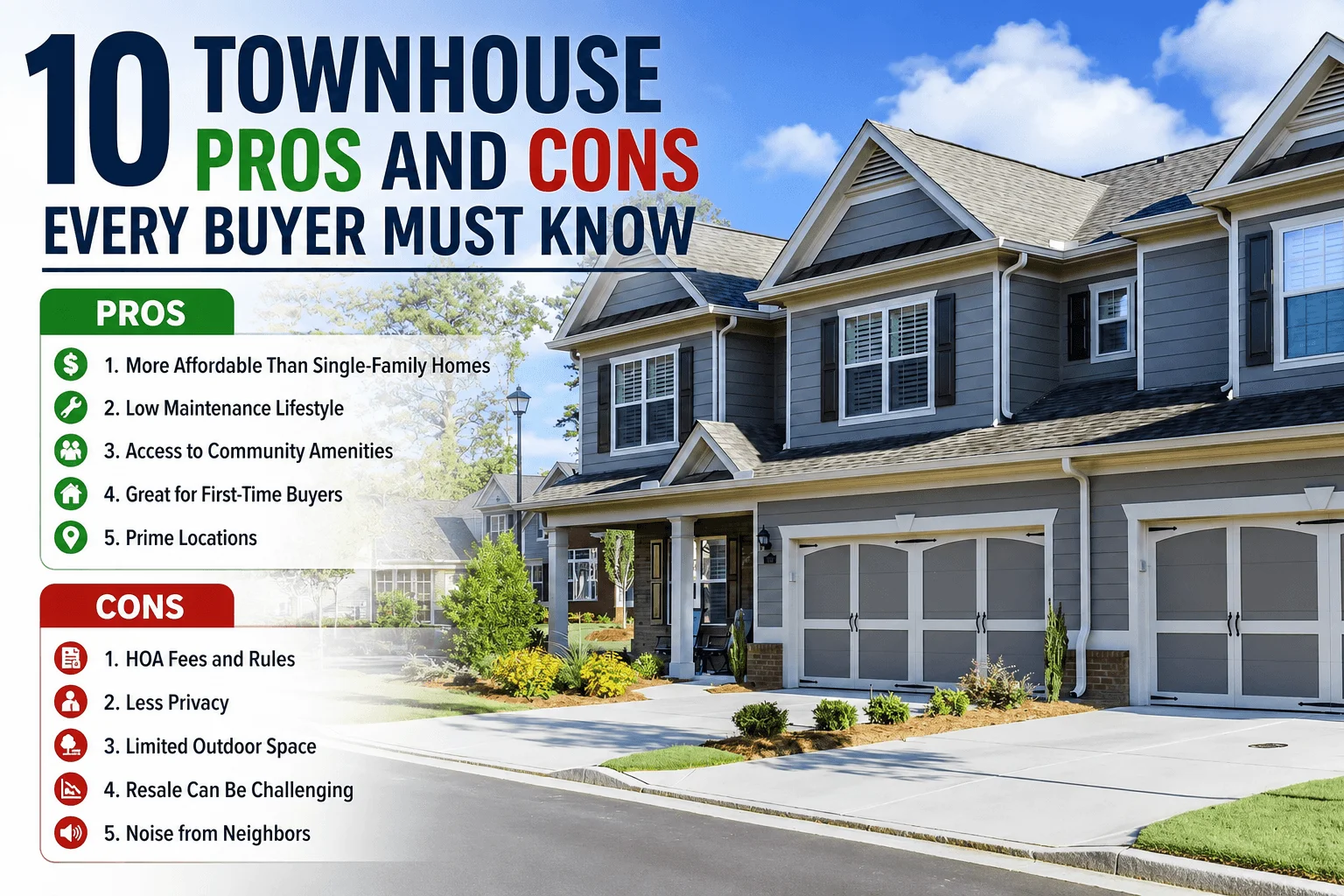
Do they fit your needs and requirements? Let us consider 10 advantages and disadvantages of townhouses and decide.
Lorem ipsum dolor sit amet, consectetur adipiscing elit. Ut elit tellus, luctus nec ullamcorper mattis, pulvinar dapibus leo.
What Is a Townhouse?
Townhouse is a multistory building that shares one or two walls with adjacent buildings.
A townhouse differs from a condo in the sense that the ownership of the structure and the ground under it is owned by the owner of the house.
Two key ownership types exist:
- Fee-simple townhouse — You own the unit and the land. Insurance is typically an HO-3 policy (similar to a single-family home).
- Condo-style townhouse — You own only the interior airspace. Insurance is an HO-6 policy (covering personal property and interior fixtures).
Always ascertain which structure is applicable before you make an offer because this has a great effect on your taxes, insurance, and renovations
10 Townhouse Pros and Cons
In order to get a clear understanding of all the aspects that come with townhouses’ pros and cons, one needs to consider every aspect from two sides. Here’s your full breakdown.
1. Lower Purchase Price — But HOA Fees Add Up
Con: According to Redfin (January 2025), the average price of a townhouse is $365,177, whereas the average price of a single-family home is $434,303.
This makes the price gap to be around $69,000; therefore, more first-time buyers can purchase a house.
Pro: HOA fees reduce this price gap drastically. The HOA fee for townhouses ranges between $200 and $500, and it increases at the rate of 3–5%. According to ListWithClever, the total monthly cost includes:
|
Property Type |
Estimated Monthly Cost |
|---|---|
|
Townhouse (~$375K) |
$3,005 – $3,701 |
|
Single-Family Home (~$446K) |
$3,601 – $4,387 |
The savings are real — but smaller than the sticker price suggests.
2. You Own the Land — But It's a Smaller Lot
Pro: This is among the most important of the pros and cons of townhouses.
With fee simple ownership, owners have rights to the ground on which the house sits. This represents an important benefit over condos, in which the homeowner owns only interior airspace.
Con: The lot is usually small, probably small enough to support just a small patio or yard. For those with large dogs, active children, or ambitions of growing vegetables, this may be very limiting indeed.
3. Multi-Story Space — But the Layout Can Feel Tight
Pros: More spacious living areas in terms of both horizontal and vertical space compared to apartments or condominiums. Having different floors provides different places for work, sleep, and relaxation.
Cons: All that space comes in a limited amount of ground area. Having stairs means you will need to take them on a daily basis, which might be difficult for senior citizens or people who have mobility problems.
4. Lower Maintenance — But Less Control Over Your Home
Pro: Majority of the HOA for townhouses take care of the maintenance of exteriors such as roof, siding, landscaping, snow removal services. It saves your weekend time and even protects you from unexpected repair costs.
Con: This luxury comes with some responsibilities. The HOA may limit you from doing things such as painting your front door, or putting up a basketball net.
If you wish to put up a fence or rent out your apartment on Airbnb, check your Covenants, Conditions, and Restrictions (CC&R).
5. Community Perks — But Less Privacy
Pro: Townhomes have access to facilities like swimming pools, gymnasiums, walking tracks, and even clubhouses.
These facilities are not something you could afford on your own, and therefore become one of the biggest advantages.
Con: Having walls shared means you will have to share sounds too. You may hear things like someone watching television or listening to music from next door.
While modern technology makes it better, there is no substitute to having space between your walls.
6. Tax Deductions Available — But You Pay Tax on House and Land
Pro: Townhouse owners can deduct mortgage interest and property tax payments from their taxes just as much as regular homeowners do.
This can greatly cut down on the taxes you have to pay each year.
Con: The fee-simple owner of a townhouse has to pay property tax for both the building and the land whereas the condominium owner pays for the interior only.
Property tax in the United States is around 1.1% on average. At this rate, you’d pay about $4,015 annually for a $365,000 townhouse.
7. More Straightforward Insurance — But Policy Type Matters a Lot
Pro: Owners of fee-simple townhouses have HO-3 policies that cover the dwelling, contents, and liability, similar to the standard homeowner’s insurance policy. It is familiar, available, and competitively priced.
Con: If your townhouse is actually set up as a condo, you will need to purchase the HO-6 insurance, which provides only interior and contents coverage, but not the exterior walls.
And one more thing to keep in mind – Fannie Mae requires special deductible requirements for the HOA to be able to finance.
8. More Freedom Than a Condo — But Less Than a House
Pro: As opposed to condos, you have greater independence while owning a townhouse. It is possible to renovate the interior, build a small patio, or change your personal backyard area without the approval of the association.
Con: You are still beholden to the association for anything that is exposed outside. Single family owners do not report to anyone (besides the zoning laws of the locality). When it comes to creativity on your property, you will win by far.
9. You Enter the Market Sooner — But Appreciation Is Slower
Pro: Lower cost of entry allows for more immediate acquisition of equity. Townhouses tend to have strong growth potential in high-demand urban environments due to limited land availability and the demand for the style of living offered there, such as Boston, Washington D.C., or San Francisco.
Con: Single family homes have historically appreciated at a higher rate. As per Rocket Mortgage’s information based on industry research, the average annual gain for SFH is between 6-9%, whereas for townhouses it is about 4-5% annually.
10. A Growing Market — But a Narrower Resale Pool
Pro: There’s growing interest in townhomes. Townhouses make up 18.3% of all new single-family starts in 2025 (NAHB).
This trend creates a foundation of lasting value, especially in areas near transportation and work hubs in urban or suburban neighborhoods.
Con: You have less choice when it comes to buyers compared to selling a standalone home. Most people with children like having a garden or backyard.
People with pets want a bigger garden too. Buyers also shy away from HOAs, especially if there’s little money left in the reserve fund.
HOA 101: What Every Townhouse Buyer Must Know
The HOA is central to nearly every townhouse pros and cons discussion. Before you buy, request and review:
- CC&Rs — rules governing what you can and can’t do
- Financial statements — look for reserves equal to at least 20% of annual operating costs
- Meeting minutes — reveals disputes, planned assessments, and unresolved issues
- Reserve study — shows whether the association is funded for major future repairs
The cost associated with the HOA covers exteriors maintenance, landscaping of common areas, amenities, snow removal, trash removal, and master insurance policy.
Do not forget about special assessments. This is an additional charge made to cover the costs incurred as a result of lack of money in reserve fund, and it may cost you a lot.
In the State of California, the management of the HOA is regulated by Davis-Stirling Common Interest Development Act. Different states have different statutes concerning HOAs. Check the statute of your state prior to buying.
Tax and Insurance: The Details That Matter
Townhouse pros and cons in the tax and insurance arena are frequently overlooked — but they’re financially significant.
Property tax: Fee-simple townhouse owners pay tax on the full assessed value of the home and land. Condo owners pay only on their interior unit. The difference can add hundreds of dollars to your annual bill.
Insurance: Confirm whether your townhouse is structured as fee-simple (HO-3) or condo-style (HO-6) before choosing a policy. The wrong policy type can leave major gaps in your coverage.
Mortgage qualification: Lenders typically count HOA fees in your debt-to-income (DTI) ratio. A $400/month HOA fee can meaningfully reduce the mortgage amount you qualify for.
Is a Townhouse a Good Long-Term Investment?
Townhouse advantages and disadvantages related to the investment aspect largely depend on the location and timing.
Townhouses may be able to compete with single-family homes in terms of appreciation rates in markets where there is scarcity of land available.
Units that have only one common wall tend to be more expensive and sell quickly. Units that have a garage, renovated interior, and strong HOA finances are also expected to hold their value well.
Overall, an investment into townhouses proves to be a good choice, particularly in case of a longer holding period of 5-10+ years..
FAQ: Townhouse Pros and Cons
What are the biggest townhouse pros and cons to know before buying?
The main pros are lower purchase price (median $365,177 vs. $434,303 for a detached home, per Redfin 2025), reduced exterior maintenance, and access to community amenities. The main cons are HOA fees ($200–$500/month), shared walls that reduce privacy, and historically slower appreciation (4–5% annually vs. 6–9% for single-family homes).
Are townhouse HOA fees negotiable?
No — HOA fees are set by the association board and are not negotiable by individual buyers. However, you can evaluate whether the fee is reasonable based on what it covers and the association’s financial health. Always request the reserve study and financial statements before purchasing.
Do townhouse owners pay more in property taxes than condo owners?
Generally, yes. Fee-simple townhouse owners pay property tax on both the structure and the land beneath it. Condo owners typically pay only on their interior airspace. At a national average rate of ~1.1% (Tax Foundation), that difference can add meaningful costs annually.
What type of insurance does a townhouse require?
It depends on the ownership structure. A fee-simple townhouse uses an HO-3 policy (standard homeowner’s insurance covering the structure and contents). A condo-style townhouse uses an HO-6 policy, which covers only the interior and personal belongings. Always confirm the legal structure of a townhouse before selecting a policy.
Can I rent out my townhouse?
Many HOAs allow rentals, but rules vary significantly. Some communities ban short-term rentals (like Airbnb) outright. Others limit the percentage of units that can be rented at any given time. Review the CC&Rs carefully before purchasing if rental income is part of your plan.


Join The Discussion