
Table of Contents
Key Takeaways :
- Your household income is well above the $103,960 state median
- You’ve budgeted for winter heating bills of $2,000–$4,000+
- You’re comfortable with a $658,000+ median home price
- You have a realistic childcare plan (or don’t need one)
- You don’t mind sharing the coast and mountains with tourists all summer
- You value top-tier schools and hospitals more than a low tax bill
Are you considering moving to New England? You are not alone in making that decision.
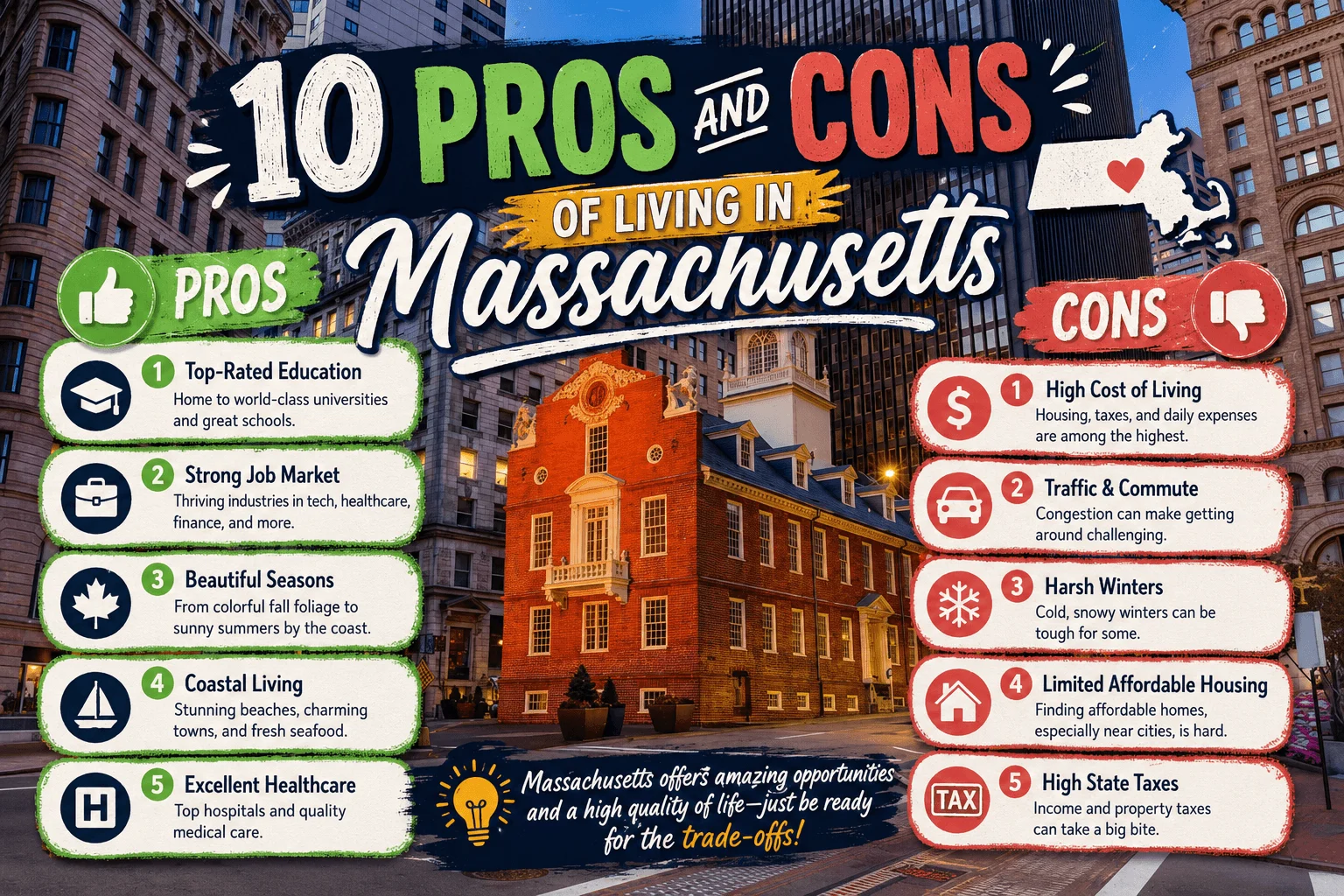
Massachusetts is home to world-class universities, high paychecks, and first-rate medical facilities; however, it is also very expensive to live there, especially in terms of homes and offices, it has harsh weather conditions, and there’s lots of traffic.
During the year from July 2024 to July 2025, the state experienced a net domestic migration loss of almost 33,000 people.
This article gives you a truthful and fact-based analysis of Massachusetts as a place to live in, free of any exaggeration and bias.
Quick Snapshot: Pros and Cons of Living in Massachusetts
The Pros
- Rank #1 for public education nationwide (NAEP)
- Emerging industry in biotech, finance, and technology
- Lowest percentage of uninsured people in the country — only 2.8%
- Breathtaking coastline, mountain scenery, and autumn leaves
- Low violent crime rate
The Cons
- Cost of living is approximately 44% higher than the national average.
- Median house prices around $660,000.
- Difficult winters – 50 to 80+ inches of annual snowfall.
- Lots of traffic and an outdated public transportation network.
- High taxes for high-income earners and estate owners.
Now let’s break down each factor in detail.

1. Education: Excellent, But Not Cheap
The Pros
- Massachusetts students are at number #1 in the USA when it comes to NAEP test results
- Lexington, Newton and Wellesley school districts rank highest in national listings year after year
- MIT and Harvard are located only two miles apart in Cambridge
- There are more than 100 colleges and universities in Massachusetts
The Cons
- Annual tuition costs at UMass Amherst range to about $20,000 annually
- Annual costs at private universities may exceed $60,000
- Financial disparities do actually exist between rich suburbs and places such as Springfield and Lawrence
Takeaway: The schools are genuinely excellent — but which town you settle in matters enormously.

2. Jobs and Economy: Big Paychecks, Big Competition
The Pros
- The second-lowest unemployment rate in the United States
- Kendall Square, Cambridge, which houses the headquarters of Biogen, Moderna, and AstraZeneca, is a hub for the large biotech industry
- More than $6.85 billion of biopharmaceutical venture capital investment in 2025 alone, according to MassBio
- Financial services companies like Fidelity and State Street make the area strong financially
- Median household income of $103,960, which is almost $30,000 higher than the national median
The Cons
- You’re frequently competing against graduates from MIT and Harvard for the same position.
- The high pay scales don’t go as far when you consider the cost of living.
Conclusion: The same income of $120,000 will bring a different standard of living for one who is moving from Massachusetts to Ohio and Tennessee.

3. Healthcare: Excellent Access, Real Costs
The Pros
- Health insurance is available to just 2.8% of the population, the lowest percentage in the United States according to the U.S. Census Bureau.
- Massachusetts’ healthcare reform act of 2006 (the model for the ACA) had strict coverage mandates and a well-developed insurance exchange system.
- Location of the Massachusetts General Hospital, Dana-Farber Cancer Institute, and Boston Children’s Hospital – some of the most prestigious hospitals in the world.
The Cons
- Massachusetts boasts one of the largest per-capita expenditures on health care in the country.
- In 2023, according to a Massachusetts Healthcare Affordability Report, many insured individuals face difficulty accessing care.
- Long waits for specialists at premier hospitals can be measured in months.

4. Natural Beauty: Gorgeous, But Crowded in Summer
The Pros
- Diverse array of scenery: The Berkshires, Cape Cod, North Shore, and Pioneer Valley
- World-renowned autumn colors, best seen from late September to late October
- Department of Conservation and Recreation controls 450,000+ acres of parks, forests, and beach areas
- Activities throughout the year: Jiminy Peak Ski Resort, Mt. Greylock hike, and bird watching on Connecticut River
The Cons
- Cape Cod, North Shore, and Berkshires become extremely congested during summer.
- The locals share their favorite places with the tourists for almost three months each year.
- The congestion caused by Cape Cod-bound travelers on Fridays in July is famous in a negative way.

5. Cost of Living and Housing: The Big Trade-Off
The Pros
- North End is one of the most genuine Italian neighborhoods in the US
Over 200 breweries in the state - 3.14 cases of violent crimes per 1,000 residents – much lower than the national average of 4.43
- Only 24 murders in Boston in 2024 – the lowest number since 1957
The Cons
- The cost of living is approximately 44% higher than the national average
- Average house price: $658,000-$662,000
- Cambridge and Brookline go above $1 million
- Average monthly rent of a one bedroom in Massachusetts: $1,459
- Monthly rental asking prices in Barnstable: $3,227
Many people
6. Taxes: Manageable, But Not Painless
The Cons
- 5% flat state income tax
- Surcharge tax of 4% on income exceeding $1 million (introduced in 2023), making it a total of 9% top tax rate
- Sales tax of 6.25% applied on most consumer products
- Boston suburban property taxes often exceed $10,000 per year
- There is an estate tax on the amount above $2 million of the estate in Massachusetts
The Pros
Social Security income is not subject to taxation by the state
Paid family leave, a $15 minimum wage, and worker protection laws
7. Weather: Four Real Seasons, One Brutal One
The Pros
- Authentic four season cycle: vibrant fall colors, warm beach summer days, and picturesque winter scenes
- Perfect for those who ski, snowshoe, and skate
The Cons
- Annual snowfall in Boston: 50-60 inches
- Snowfall in western Massachusetts: 80+ inches
- Nor’easter can bring 18-30 inches in one day
- December sun sets before 4:15 p.m. and seasonal depression syndrome is very common among locals
- Spring comes late, in late April/early May
- It can cost from $2,000 to $4,000+ for heating bill in winter – don’t forget about snow tires and proper winter clothes
8. Traffic and Transit: The Daily Grind
The Pros
- The job market and culture of Greater Boston still are world-class — firms started by graduates from MIT alone have a worldwide workforce of more than 3 million
The Cons
- Boston is one of the five most congested cities in the U.S.
- Average commute in Massachusetts = 29.1 min — more than the average across the country
- Underfunded and unreliable MBTA subway and commuter rail system
- There is practically no public transportation outside of Greater Boston — western and central MA have to rely on cars
- Parking downtown Boston is $200-$400 per month
9. Climate Risk and Infrastructure: A Growing Challenge
The Pros
- Cleaning up the Charles River and Boston Harbor are significant environmental achievements
- Boston’s air quality is among the finest in the country
- Wind power is being developed offshore, and rural broadband access is growing to cover 92.8% of Massachusetts residents
- Massachusetts leads the way in renewables and has set a goal of generating 80% renewable energy by 2050 and ranks highly when it comes to solar energy usage per capita
The Cons
- Massachusetts sea level is expected to increase by between 2.3 and 4.2 feet by 2070 in some scenarios – Mass.gov
- There are increased flooding risks in East Boston, South Boston, Seaport, Cape Cod, Nantucket, and Martha’s Vineyard
- There have been 45 billion-dollar weather disasters in Massachusetts since 1980 as reported by NOAA
- 15% of the roads in Massachusetts are in poor condition while bridge deficiencies have increased by 9%
10. Family Life: Great Schools, Brutal Childcare Costs
The Pros
- One of the best places to raise children in the whole country — provided that you have the means
- Great public schools throughout virtually all suburbs
- Family paid leave, robust tenant laws, and LGBTQ rights legislation
The Cons
- Baby care costs around $26,000 annually (around $2,200 monthly)
- A couple with two kids will incur an annual cost of $40,000-$50,000 just on child care
- No state in America has higher child care costs than D.C.
- There are government subsidies, but there is a long waiting list – many two-income families make too much for subsidies yet not enough to pay for it
FAQ'S
Is Massachusetts an expensive place to live?
Yes. The cost of living runs about 44% above the national average, and the median home price sits around $658,000–$662,000.
What’s the biggest downside of living in Massachusetts?
Most people point to cost of living and winter weather — Boston averages 50–60 inches of snow a year, and housing eats up 35–50% of income for many residents.
Are Massachusetts public schools really the best in the country?
By one major measure, yes — Massachusetts ranks #1 nationally on the NAEP. Quality varies a lot by town, so research your specific district before you move.
How much does healthcare cost in Massachusetts?
Coverage is excellent — only 2.8% of residents are uninsured, the lowest rate in the U.S. — but the state also has some of the highest per-capita healthcare spending in the country.
What is the Massachusetts income tax rate?
It’s a flat 5%, plus an additional 4% surtax on income above $1 million, for an effective top rate of 9%.


Join The Discussion