
Property tax relief may be just around the corner for many homeowners in Florida, but how much relief there will be, and at what cost, won’t be known until November arrives.
Following a special legislative session held this week, lawmakers in Florida have now approved a ballot proposal that aims to increase Florida’s homestead exemption. With votes of 75-26 in the House and 30-9 in the Senate, the proposal heads to Florida voters to approve by a 60 percent margin.
This appears likely to occur, according to polls taken in April that found support for increasing the homestead exemption stood at 77 percent among Florida voters. Among those voters, 53 percent would definitely support the ballot item, with an additional 24 percent also indicating their approval.
What the Proposal Would Actually Do
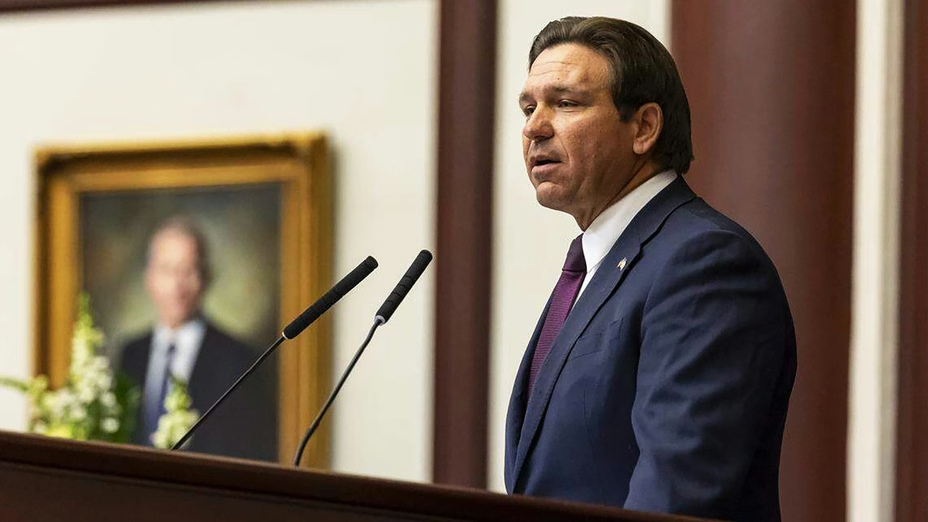
Under this proposal, called “Save Our Homes From Excessive Property Taxes” and spearheaded by Governor Ron DeSantis, Florida residents would be able to claim a higher percentage of the value of their homes’ worth free of property taxes.
Although Florida has a small amount of homestead tax exemption currently, it doesn’t reflect the rapid appreciation in value of many Florida real estate homes. This new plan would remedy that.
Starting on January 1st, 2027, the first $150,000 worth of assessed valuation of one’s property would be exempt from property taxes. For 2028, that number goes up to $250,000, and afterwards is adjusted according to the rate of inflation every single year.
Governor DeSantis claimed that this $250,000 exemption point would ensure that 60% of Floridians don’t pay any property taxes at all. However, according to an independent analysis done by the Florida Legislative Office of Economic and Demographic Research, approximately only 28% of homesteaded properties would be below the $250,000 exemption point.
Assessed Value vs. Market Value: Why the Difference Matters
The property taxes a person is required to pay in Florida are not always in accordance with the market value of their home. This is due to the fact that in Florida there is a cap on the amount of increase that is allowed each year in the assessed value of homesteaded properties. Over time, this could lead to a large difference in the value of the property assessed against the market price.
For instance, an old resident in Miami might own a property that has a market value of $500,000; however, since the increase in the assessed value has been capped over the years, he/she may be assessed at a much lower amount, say $200,000. On the other hand, the assessment value of a new purchaser of an almost similar home in the neighborhood will not be capped since this is a brand new transaction.
Thus, the new exemption is likely to have a disparate impact based on the assessed value of the property.
The $8 Billion Question Nobody Has Answered
Wide public acceptance of the exemption does not render the core policy dilemma moot: someone will have to take on the slack if homeowners pay less.
According to an analysis conducted by the staff of the Florida House, the proposal could result in a reduction of over $8 billion in local government revenues in just the first year alone, rising to over $14 billion in the second year. The cutbacks would span all local property taxes, whether for public schools or other local governmental services such as fire departments and the sheriff’s office.
The problem is especially acute for rural counties. In the course of floor debate, Democratic state Rep. Allison Tant of Tallahassee specifically pointed out what challenges counties such as Jefferson and Madison face, where their respective public school districts account for some of the county’s largest employers.
Republican state Rep. Toby Overdorf, who supported the measure, acknowledged the proposal offers no clear answer. “The governor’s resolution is silent on how to fund government,” he said.
That silence concerns fiscal watchdogs. Florida TaxWatch, a nonpartisan research group, praised the broader goal of property tax relief but warned that without guardrails on local spending, the savings for homeowners could simply shift the burden elsewhere. The group cautioned that local governments might respond by raising other taxes, fees, or assessments—or passing costs on to owners of non-homestead properties like rental units and vacation homes.
A provision that would have created a state trust fund to help rural and low-population counties replace lost revenue was stripped from the final version before the vote.
What Comes Next
This initiative will be featured in the November 2026 election. In the event that the proposal passes with a minimum of 60% voter support, the extended exemption is added to the state constitution starting in January 2027.
For frustrated Florida homeowners suffering from increased taxes, the upcoming vote may be their answer. It remains unclear whether someone else will pick up the tab or if service quality will take a hit.


Join The Discussion